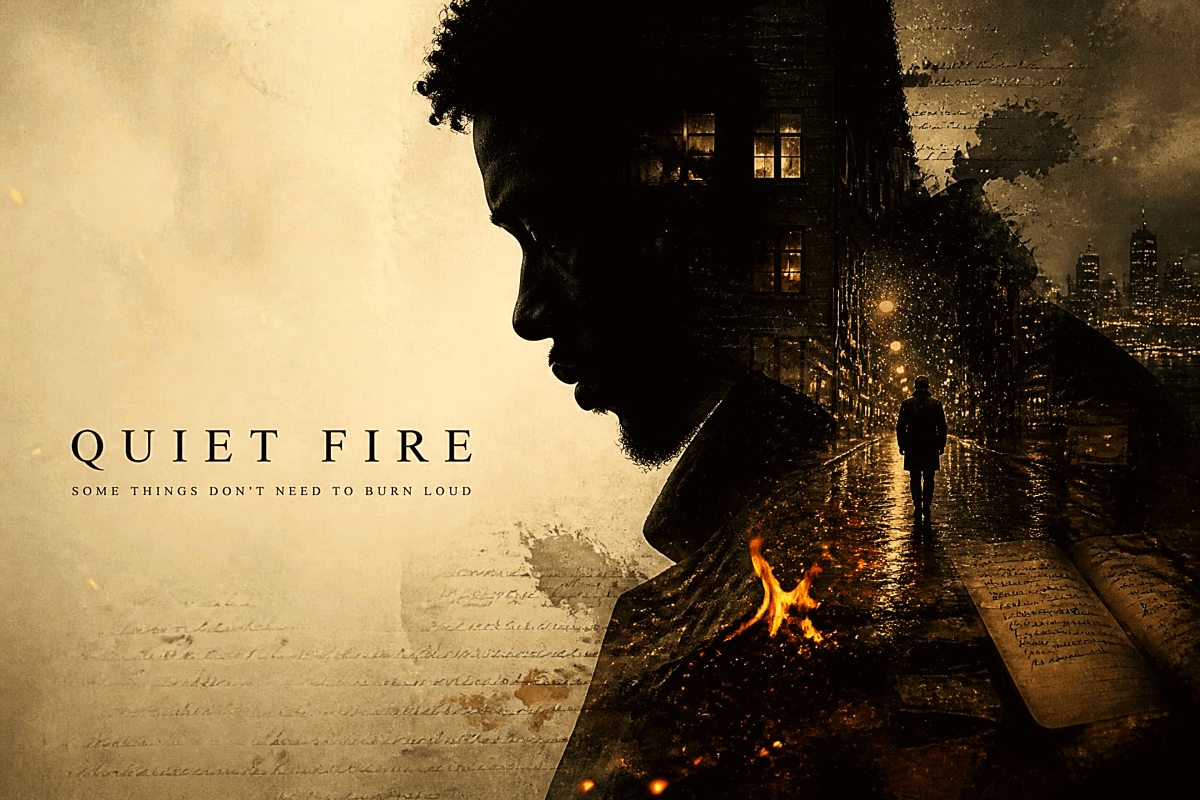
Quiet Fire – Entry 29
The house had become too quiet since Evelyn died, although Walter would have argued that the house itself had nothing to do with it. Houses did not become lonely. People became lonely and blamed the architecture because drywall could not argue back. He had explained this to his daughter twice during the past week, once when she suggested he spend a few nights at her house and again when she arrived carrying brochures for three assisted-living communities, all of them filled with photographs of suspiciously cheerful old people playing cards beneath chandeliers.
Walter had looked through the first brochure long enough to discover that one of the places offered something called mindful movement on Tuesday mornings, then handed the entire stack back to her.
“I know how to move,” he said.
“Dad.”
“I’ve been doing it for eighty-one years.”
“That isn’t what I mean.”
“I know exactly what you mean, which is why I’m choosing to misunderstand you.”
She had inherited Evelyn’s expression for moments like that, the slight tightening around the mouth that meant she was deciding whether murder would create more inconvenience than satisfaction. Walter almost told her so, but grief had made certain jokes dangerous. There were still places inside him where Evelyn’s name struck bone.
His children meant well, which somehow made the whole damned thing worse. If they had been greedy bastards circling the house for furniture and insurance money, he could have thrown them out and enjoyed doing it, but they were worried about him. They called in the morning to make sure he had awakened, called in the evening to make sure he had eaten, and appeared without warning carrying casseroles large enough to sustain an infantry platoon through winter. Somewhere between their mother’s funeral and the reading of the obituary, his children had apparently promoted themselves to his commanding officers.
Who the hell did these kids think they were?
He had been getting by before any of them had existed. He had crossed an ocean wearing government-issued boots, slept beneath skies that shook from artillery, come home with letters folded into his duffel and memories he had spent the next sixty years pretending did not wake him occasionally at three in the morning. He had married Evelyn when neither of them had enough money to be sensible about it, raised three children through influenza, broken bones, report cards, first dates, slammed doors, college tuition, marriages, divorces, grandchildren, and the thousand ordinary catastrophes from which families were constructed. Yet somehow his inability to remember where he had put his reading glasses last Tuesday had become evidence that he could no longer be trusted with a toaster.
Still, he had agreed to clean out the house.
That was how they phrased it.
Clean out.
As though fifty-seven years of marriage had accumulated in the corners like dust.
By Saturday afternoon, Walter had managed one closet, half of the linen cabinet, and approximately eighteen inches of the bookshelf in the den before deciding that civilization could survive another day without his contribution. Everywhere he looked, Evelyn remained disguised as an object. Her blue sweater hung behind a coat she had not worn in years. Her gardening gloves rested on the basement shelf with dirt still pressed into the fingertips. A chipped ceramic bowl sat above the refrigerator because she had refused to throw it away despite Walter pointing out, with what he considered impeccable logic, that they owned several bowls that were not broken.
That isn’t the point, she would say.
He had never discovered what the point was.
Now he couldn’t ask.
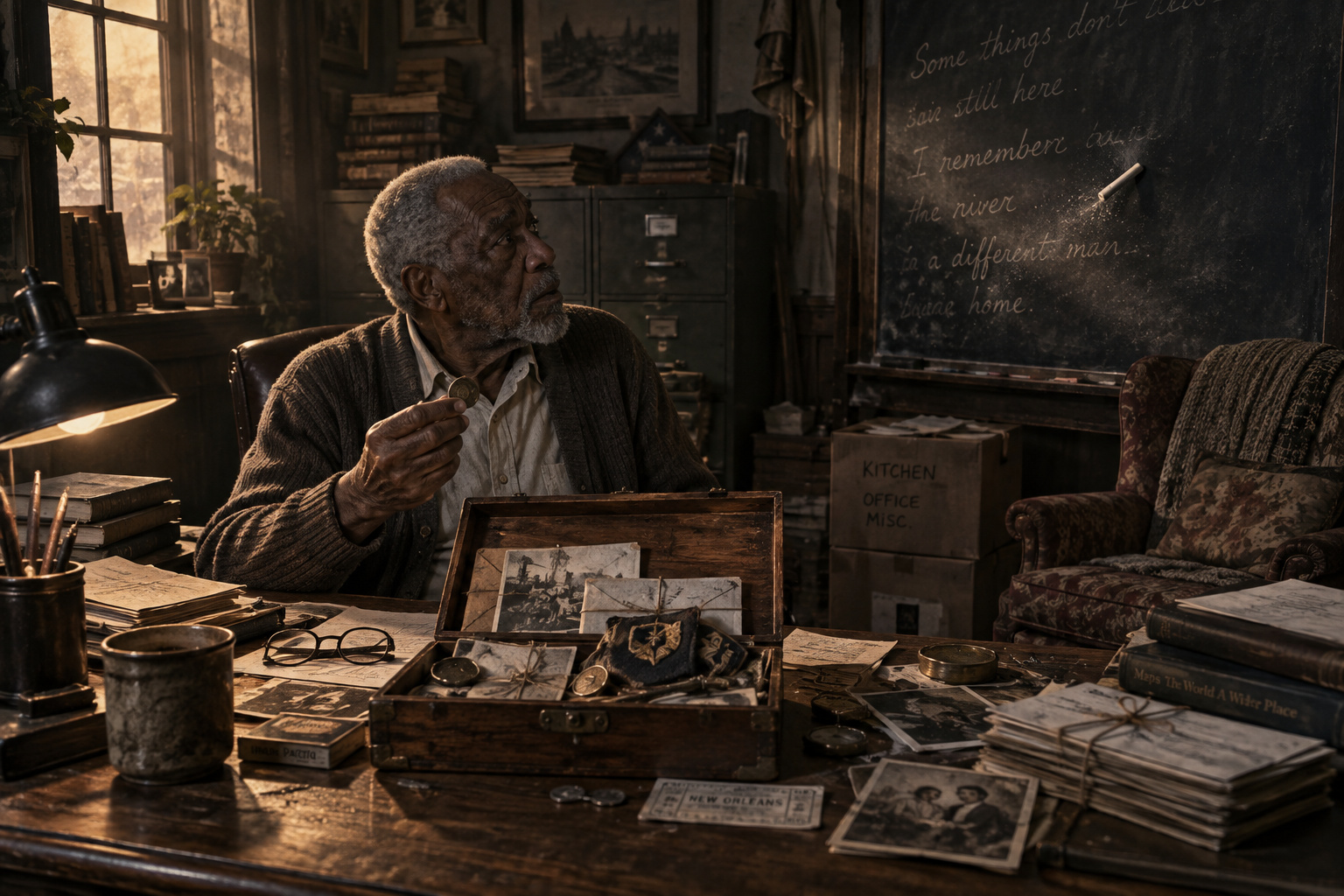
Walter carried a cardboard box into his office and lowered it beside the desk, pausing until the dull complaint in his lower back subsided. The room smelled of old paper, furniture polish, and the faint mineral dryness of chalk, although he had not used the blackboard mounted on the far wall in years. He had brought it home after retiring from Franklin High, back when the district had decided that interactive whiteboards represented progress and thirty-seven years of chalkboards represented something apparently shameful. Evelyn had laughed when he wrestled the thing through the front door.
“You retired from teaching, Walter.”
“I retired from the school.”
“There is a difference?”
“Apparently.”
She had rolled her eyes and helped him mount it anyway.
Now the board was covered with faint remnants of old scribbles, fragments of words and crooked lines emerging through the gray-black surface as afternoon sunlight crossed the room. Walter stood before it, rubbing his thumb against one particularly stubborn mark.
“Hmmm,” he murmured. “Thought I erased those.”
He considered finding the eraser, decided the board had survived this long without his intervention, and lowered himself into the chair behind the desk. There were practical things he was supposed to accomplish before his daughter returned tomorrow, including deciding which books he wanted to keep and whether the filing cabinet contained anything worth saving. Instead, Walter noticed an old cigar box wedged behind a row of encyclopedias on the bottom shelf.
He recognized it immediately.
The cigars themselves had disappeared sometime during the Carter administration, but the box had followed him through three houses and at least four arguments with Evelyn about why a man who no longer smoked cigars needed a cigar box.
Walter set it on the desk.
The brass clasp resisted before surrendering with a brittle click, releasing the dry smell of cardboard, old paper, and something faintly metallic. Inside lay the archaeological remains of a life nobody would have considered important enough to excavate: postcards with curled corners, letters bound with a rubber band that had hardened into something resembling amber, foreign coins, two photographs, a hotel matchbook, a train ticket, an army insignia, three keys whose locks had long since disappeared, and several objects Walter himself could not immediately identify.
He picked up a broken brown button.
For several seconds, nothing came.
He turned it between his thumb and forefinger, studying the pale thread still caught through two of its holes. It was too large for a shirt and too plain for anything Evelyn would have worn. Walter nearly dropped it into the wastebasket beside the desk before something shifted inside his memory.
Rain.
Not ordinary rain, but the cold sideways rain of November, driven beneath collars and through seams until every piece of clothing weighed twice what it had that morning. He remembered wool scratching his neck. Diesel exhaust. Mud thick enough to steal a boot. A young man named Henry Dobbs swearing at a truck that refused to start while Walter laughed from beneath a poncho that had already surrendered its claim to waterproofing.
The button had come from his field jacket.
Walter closed his fist around it.
He could see Dobbs now, nineteen years old and skinny as fence wire, grinning through the rain with a cigarette stuck to his lower lip. Walter remembered the truck coughing alive, remembered someone cheering, remembered reaching for the passenger door and catching his jacket against a piece of metal. The button had snapped free and landed in the mud.
Dobbs had picked it up.
Better keep that, Teach. Government’s gonna charge you for it.
Walter smiled despite himself.
He had forgotten Dobbs.
Not the name exactly, because names could survive in places where faces did not, but he had forgotten the sound of his voice and the ridiculous way he smoked cigarettes in the rain. He had forgotten the truck and the mud and the button. He had forgotten being twenty-two years old and believing that surviving until breakfast qualified as a long-term plan.
Then he heard the chalk.
The sound was unmistakable.
A dry scrape traveled across the room behind him, followed by a pause and another deliberate stroke.
Walter remained still.
The house had made strange noises since Evelyn died. Pipes knocked. Floorboards complained. The refrigerator occasionally produced a groan suggesting that some large animal had become trapped behind the vegetable drawer. Grief sharpened ordinary sounds until they seemed intentional, and Walter had learned not to investigate every creak merely because some foolish part of him hoped Evelyn had returned from the dead to complain that he had left a light burning downstairs.
The scratching came again.
Walter turned.
A piece of white chalk rested against the blackboard.
There was no hand holding it.
Walter stared long enough for his rational mind to offer several explanations and reject every one of them. The chalk moved slowly across the surface, dragging itself through a line of pale dust while letters appeared behind it.
November rain came sideways that morning.
Walter’s fingers tightened around the button.
The chalk continued.
It wrote about the truck.
It wrote about the mud.
It wrote Henry Dobbs’s name.
Walter rose so quickly that the chair rolled backward and struck the filing cabinet. His first instinct was to leave the room, which irritated him enough that he stayed. He had survived men shooting at him, teenagers armed with hormones and bad attitudes, three children learning to drive, prostate surgery, and nearly six decades of marriage to a woman who considered surrender a character defect. He was not going to be chased from his own office by a piece of chalk.
Besides, it had misspelled Dobbs.
“Two b’s,” Walter said.
The chalk stopped.
A moment later, it returned to the name, erased the final letters, and corrected them.
Walter stared at the board.
“Well,” he murmured, “at least you’re teachable.”
The chalk resumed its journey.
The story spread across the blackboard in Walter’s own familiar handwriting, although he knew with absolute certainty that he had never written those sentences. It described Dobbs retrieving the button from the mud, polishing it unnecessarily against his filthy sleeve, and dropping it into Walter’s palm. It described the two young men laughing because laughter was easier than admitting they were frightened. Then it recorded something Walter had forgotten entirely.
You kept it because Henry did not come home.
Walter’s amusement disappeared.
The button suddenly felt heavier.
For more than half a century he had remembered Henry Dobbs as a name attached to a war, one among several names he had learned not to visit too often. He had forgotten that Henry had given him the button. Forgotten that he had carried it home. Forgotten that sometime afterward he had placed it inside a cigar box and allowed decades to gather around it.
Walter lowered himself into the chair.
For a long while, neither he nor the chalk moved.
Late-afternoon light stretched farther across the floor until it touched the legs of Evelyn’s empty reading chair in the corner. Walter looked from the button to the cigar box, where dozens of other objects waited without explanation, and understood with a sensation somewhere between wonder and dread that he had no idea what most of his own possessions meant anymore.
He reached into the box again.
This time he selected the matchbook.
The chalk lifted from the tray before he remembered anything at all.
Discover more from Memoirs of Madness
Subscribe to get the latest posts sent to your email.


Wow… 😳 I have not read a novel since I was a kid so I don’t know much about writing but there’s so much in how these words come together. Artistic and skilled. I wonder who had the chalk?🤔 Also, you made an old man interesting. There’s a thousand old men in you!
LikeLike
How delightfully eerie, provocative, intriguing! I don’t quite have shivers but close enough! Go Walter!
LikeLike