
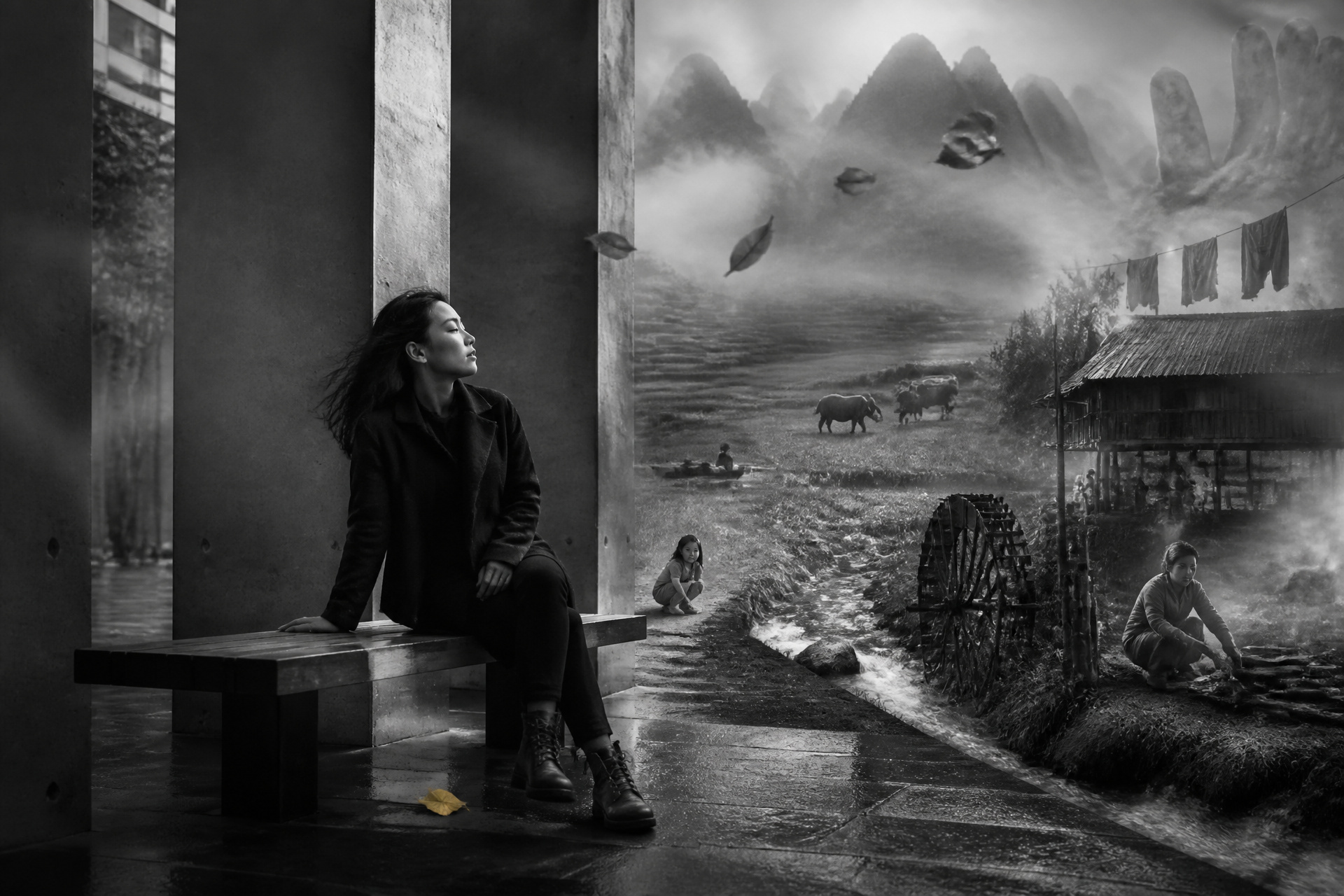
She came to the bench when the wind was undecided.
That was when it talked the most.
Not during storms, despite what people might imagine if she were foolish enough to tell them. Storms were useless. Too much noise, too much weather showing off, throwing branches around and rattling windows like some drunk who had discovered percussion. She preferred afternoons when the air wandered without apparent purpose, slipping around buildings and beneath benches, worrying scraps of paper along the pavement before abandoning them somewhere else.
Usually, she went to the old bench beneath the tree, where the wind came across the open ground without having to negotiate concrete, glass, traffic, perfume, cigarette smoke, somebody’s lunch, and all the other debris people insisted on putting between themselves and the world. There she could sit with her notebook and listen until something worth remembering arrived.
Today she didn’t have that luxury.
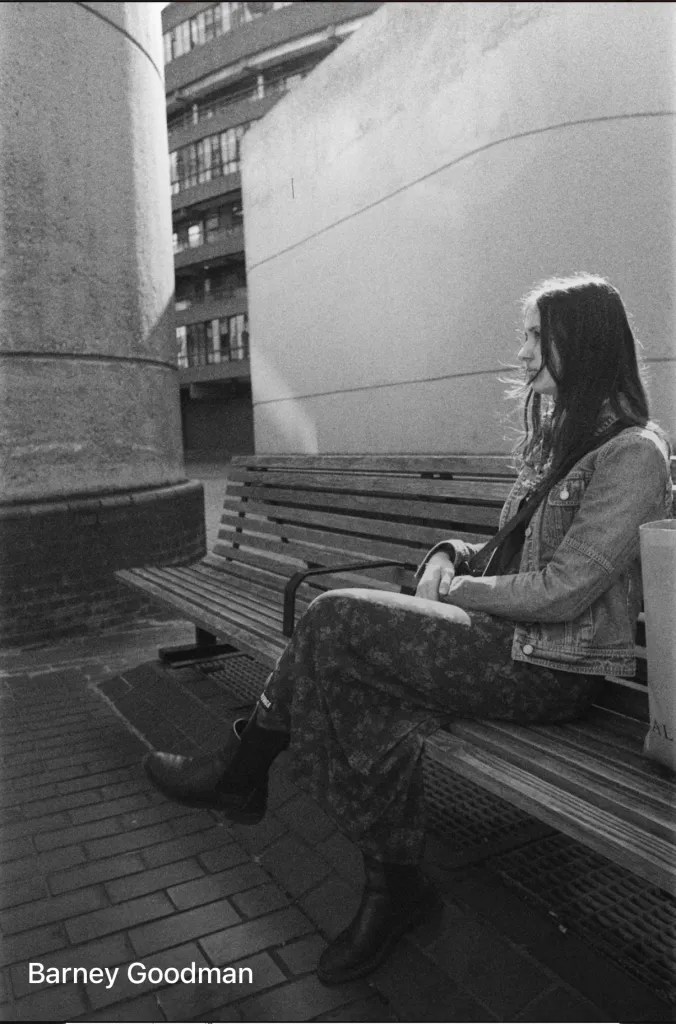
Today she had forty minutes, an uncomfortable bench between concrete columns, and a city doing everything in its power to drown the wind out.
She sat anyway.
Because sometimes you didn’t choose where the stories found you.
Anyone passing would have seen a woman doing nothing.
She had become exceptionally good at doing nothing.
The city moved beyond the courtyard in the ordinary ways cities move when nobody is paying attention. Tires hissed across pavement still damp from an earlier rain. Somewhere a truck backed toward a loading dock, its warning alarm repeating with mechanical patience. A door slammed. Someone laughed. A siren rose several streets away and faded toward whatever misfortune had summoned it.
She rested one hand on the closed notebook beside her and waited.
Then the wind shifted.
She tilted her head.
There.
Woodsmoke.
It was faint enough that another person might have dismissed it, but she knew better than to dismiss anything the wind carried. She breathed through her nose and caught it again, warmer this time, followed by something she couldn’t immediately identify. Rice, perhaps, but sweeter, wrapped inside something green. Bamboo. The smell of grain steaming inside its own little chamber above a fire.
She closed her eyes.
“All right,” she whispered. “Where are we going?”
The city began disappearing.
It always happened that way. Never dramatically. Reality didn’t tear open. There were no flashes of light, no thunderclaps, no celestial assholes blowing trumpets. One world simply surrendered to another by degrees, as though reality itself had grown tired of arguing about which version deserved to remain.
The truck disappeared first.
Then the traffic.
Then the siren.
Water took their place.
Running water, close enough that she could distinguish its movement around stones, and beneath it came a slow wooden complaint.
Creak.
Water.
Creak.
Water.
Creak.
Something large was turning.
Insects joined the sound, hundreds of them hidden somewhere beyond sight. A bird called once from high above. Chickens muttered and scratched beneath a wooden floor. Someone chopped something against a board—three quick strikes followed by silence—and from farther away came voices, people speaking casually enough that nobody had bothered lowering their voices for a stranger.
She opened her eyes.
The concrete columns were gone.
Mountains had taken their place.
Rice terraces descended through the valley in enormous green steps, some bright beneath the afternoon light, others dark where clouds had laid shadows across them. A bamboo waterwheel turned in the stream below, lifting water in patient increments and spilling it toward channels cut into the hillside.
Creak.
Water.
Creak.
Water.
A woman crouched beside a small fire beneath a stilt house. Smoke curled around her before drifting through the structure’s wooden supports. Several lengths of bamboo rested near the embers. The woman reached for one, turned it, considered something only she understood, then returned it to the heat.
Pù Luông.
The name arrived without sound.
Names always did.
They appeared inside her with the peculiar familiarity of something remembered, although she had never been here, had never walked these terraces or climbed the wooden steps into these houses. She had never heard these particular chickens complaining about whatever chickens found objectionable in the world.
One of the bamboo tubes was split open.
Steam escaped.
The scent struck her immediately—sticky rice, bamboo, woodsmoke, something almost nutty beneath it—and her stomach answered with an embarrassing little growl.
She looked down.
“Seriously?”
A child ran beneath the house and sent the chickens scattering.
The woman cooking laughed.
Someone called from somewhere uphill.
The waterwheel continued turning.
For several seconds there was nothing mysterious about any of it. No tragedy waited around the corner. Nobody appeared carrying some cryptic message meant only for her. There was food being prepared, children misbehaving, chickens taking offense, water being persuaded uphill through an arrangement somebody’s grandfather probably understood better than any engineer.
Life.
That was all.
And perhaps that was enough.
The wind changed direction.
The valley vanished.
Concrete returned beneath her boots. The bench pressed against the backs of her thighs. Traffic poured into the silence so quickly that she almost resented it.
She breathed out slowly.
“That wasn’t so bad.”
The wind moved across her cheek.
She had learned not to interpret that sort of thing as an answer.
Mostly.
Another current slipped between the buildings, colder than the first, carrying damp leaves and earth. She caught smoke again, though this time something sharper traveled inside it, citrus and spice, an aroma that hovered between pepper and something darker.
She closed her eyes.
“Still Vietnam?”
The wind didn’t answer questions.
It had standards.
The image came slowly.
People sat around food spread across banana leaves. Chicken cooked with sour bamboo shoots. Wild greens. Fish grilled until its skin had blackened along the edges. Rice cooked inside bamboo again, though the fragrance surrounding this meal was different, deeper, touched by an aromatic seed she didn’t know.
Later, perhaps, she would learn its name.
Hạt dổi.
For now, the wind asked only that she remember the smell.
The people around the meal were Mường. She knew that in the same impossible way she knew the names of places she had never visited. Someone poured rice wine. Someone else reached across the food and had their hand slapped away, provoking laughter from the others. Two older women continued a conversation apparently far more important than whatever foolishness was happening around them.
Then a gong sounded.
The note entered her before she heard it.
Deep.
Bronze.
Ancient without needing to advertise the fact.
Its vibration traveled through the vision, across whatever impossible distance separated them, and settled beneath her sternum.
She opened her eyes.
Concrete.
Buildings.
Bench.
The gong remained.
She placed two fingers against her chest and felt the echo there.
Once.
Twice.
Then nothing.
She waited several seconds.
“You’re getting dramatic.”
A scrap of wind lifted the hair from her cheek.
She smiled despite herself.
“Yeah. Takes one to know one.”
This time the wind came carrying water.
Not the clean movement of a mountain stream. Something larger. Deeper. The smell changed with it: vegetation soaked through with humidity, mud warmed beneath a hidden sun, old wood carrying the memory of countless rains.
The courtyard dissolved beneath mist.
A lake appeared.
Ba Bể.
Mountains rose around dark water while morning mist drifted low enough to obscure where water ended and sky began. A narrow boat emerged slowly from the gray, guided by an old man seated near the stern. His paddle entered the water with barely a sound.
Dip.
Pull.
Dip.
Pull.
She watched him.
He wasn’t looking at the mountains.
He wasn’t watching where he was going.
He stared at the empty seat opposite him.
There was something about the way he looked at that absence that made her chest tighten.
She knew that look.
Some absences developed weight. They sat beside you. Ate with you. Slept in the other half of the bed. Followed you into grocery stores and waited patiently while strangers asked how you were doing.
She looked away from him.
The wind shifted before she could decide whether she wanted to know more.
Mountains sharpened around her.
Rice fields.
A river threading through them.
Buffalo standing knee-deep in mud.
Phong Nam Valley arrived without ceremony, without the visual grandeur the other places seemed almost incapable of avoiding. A motorcycle struggled along a narrow road. A dog barked somewhere uphill. Water moved through an irrigation channel. Someone hammered metal in a nearby house. A woman called to someone she couldn’t see, waited, then called again with considerably less patience.
Laundry hung damp beneath an overhang.
A dented cooking pot rested upside down beside a doorway.
A man crouched beside something mechanical that had apparently offended him.
A grandmother chased a chicken away from whatever the chicken had decided belonged to it.
She smiled.
This was what she loved about the wind.
It rarely showed her monuments.
It showed her Tuesdays.
Places where nobody had prepared for strangers. People whose shirts didn’t match, whose houses needed paint, whose children had dirty knees and whose dinner might burn because somebody had gotten distracted telling a story. Lives occurring without witnesses. Nobody performing authenticity because nobody knew there was an audience.
The wind didn’t bring postcards.
It brought evidence.
Someone had been here.
Someone was here now.
Then she saw the little girl.
She crouched beside the road with a stick in her hand, drawing circles in the dirt.
One inside another.
Inside another.
Inside another.
The woman leaned forward.
Something had changed.
She couldn’t identify what at first.
Then she realized.
The dog had stopped barking.
The motorcycle was gone.
The hammering had ceased.
No voices.
Even the irrigation water seemed to have forgotten how to move.
The girl stopped drawing.
She raised her head.
Slowly.
Not toward the village.
Toward her.
The woman gripped the edge of the bench.
“No.”
The girl looked directly at her.
That had never happened.
People inside the fragments sometimes seemed to glance in her direction, but there had always been another explanation—a sound behind her, another person, coincidence arranging itself badly.
This wasn’t that.
The child’s eyes found hers.
Held them.
The girl whispered something.
The woman didn’t speak Vietnamese.
She understood anyway.
Come.
Her fingers tightened around the bench.
“What did you say?”
The vision shattered.
The courtyard returned violently enough to make her gasp.
Traffic.
Concrete.
Brick.
The bench.
Her heartbeat.
She looked around.
Nobody had noticed anything.
A man crossed the far end of the courtyard carrying a paper cup. Somewhere a woman argued into her phone. The truck was still backing toward the loading dock.
The world had continued without her.
She remained perfectly still.
Usually, that was the end.
The wind delivered whatever fragment it had carried across oceans and mountains, allowed her to witness some piece of somebody else’s existence, then moved along. She had never understood why. Years ago she had stopped asking. Some questions became smaller when answered.
She waited.
Nothing.
“Okay.”
She reached for the notebook.
That was when the smell arrived.
She stopped.
Not smoke.
Not rice.
Not river mud or damp leaves or charcoal or spices.
Stone.
Cold stone after rain.
Her hand remained suspended above the notebook.
“No.”
The temperature dropped.
The courtyard sounds disappeared.
There were no birds to replace them.
No water.
No voices.
No insects.
Nothing.
The absence frightened her more than anything the wind had ever carried.
Then the image formed.
Clouds moved beneath her.
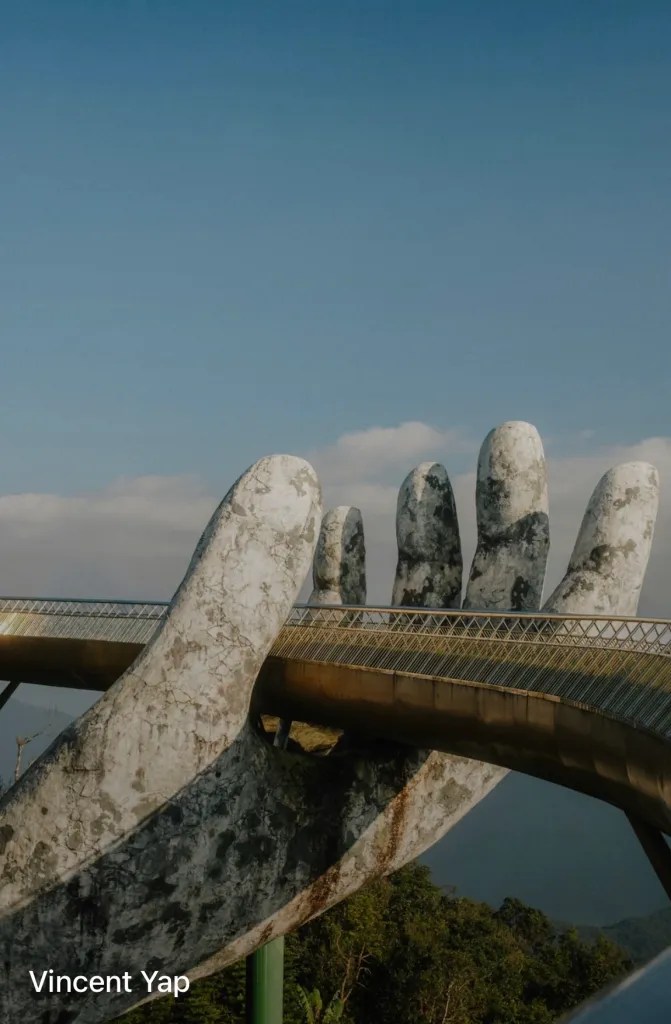
A bridge curved across a mountainside, impossibly suspended between enormous weathered hands rising from the earth. Their stone fingers were mottled with dark stains, ancient-looking despite belonging to something built by human beings.
She knew this place.
The Golden Bridge.
Bà Nà Hills.
Near Đà Nẵng.
She had seen photographs.
Everyone had seen photographs.
That was precisely what was wrong.
The wind never brought postcards.
There should have been people everywhere.
Tourists taking photographs. Couples posing. Children running ahead of exhausted parents. Voices overlapping in half a dozen languages.
There was nobody.
Only a man.
He stood perhaps thirty feet away with his back toward her, gray shirt moving in the mountain wind.
Waiting.
She couldn’t feel the bench anymore.
Her boots touched the bridge.
She looked down.
Stone beneath them.
She had never crossed before.
That was another rule.
She witnessed.
Nothing more.
“Who are you?”
The man didn’t move.
She took one step.
The wind screamed.
Images struck her faster than thought.
The woman beneath the stilt house.
The bamboo splitting open.
Steam.
The old man staring at the empty seat.
A gong.
The girl drawing circles.
A hospital corridor.
Rain hammering against a metal roof.
Hands.
Old hands.
One finger crooked by a scar.
A photograph burning from its edges toward the center.
The little girl.
Come.
Then the man began turning.
She couldn’t move.
Not because she was frightened.
Because something inside her recognized him.
His shoulder first.
His chin.
Almost his face—
The world collapsed.
She was thrown backward against the bench.
Air tore into her lungs.
The courtyard slammed into existence around her with almost obscene normality.
A car horn.
Footsteps.
Somebody laughing.
The smell of coffee from the cup in the stranger’s hand.
She sat frozen.
Her palms hurt.
She looked down and discovered splinters of wood embedded beneath her fingernails where she had gripped the bench.
“Son of a bitch.”
The wind moved away.
She waited for her breathing to settle.
One minute.
Perhaps two.
Then she noticed something between her boots.
A leaf.
Yellow.
Small.
Wet along one edge.
She stared at it.
There were no trees in the courtyard.
She didn’t touch it.
For the first time since the wind had begun speaking to her, she didn’t want to know.
Across the world, clouds moved through the mountains outside Đà Nẵng.
Tourists walked the Golden Bridge beneath enormous stone hands, taking photographs and laughing and complaining about the weather.
Nobody noticed the man standing near the railing.
Nobody noticed when he turned his head.
He was listening.
And somewhere between Vietnam and a bench thousands of miles away, the wind changed direction.
Author’s Note
My gratitude and appreciation to Sadje for the challenge that sent this story wandering in a direction I never expected.
That is one of the things I enjoy most about these prompts. Sometimes they give me a destination; other times they simply crack open a door and leave me standing there wondering what the hell is on the other side. This time, I found a woman sitting quietly on a bench, listening to the wind—and before I knew it, that wind had carried me halfway around the world.
Thank you, Sadje, for the spark, the inspiration, and another invitation to follow an idea wherever it decided to go.
Apparently, in my little corner of madness, even the wind has stories to tell.
— Mangus
Discover more from Memoirs of Madness
Subscribe to get the latest posts sent to your email.


This is excellent storytelling Mangus. A very unique idea and an absorbing story my friend. I loved the plot. Thanks for joining in.
LikeLiked by 1 person
Thank you, Sadje. I really appreciate that, my friend.
This one surprised the hell out of me. 😂 I started with a woman sitting on a bench listening to the wind, and I thought I had a reasonably good idea where the story was going.
Apparently, the wind had other plans.
Once it started carrying her into those different places, I became just as curious as she was about what she would encounter next. Then the little girl looked directly at her, and that changed everything. At that point, I realized I wasn’t writing quite the story I thought I was writing anymore.
Those are some of my favorite moments as a writer—when the story stops asking permission and starts telling me where we’re going.
Thank you again for providing the spark that sent this one wandering halfway around the world. I had a wonderful time following it.
LikeLiked by 1 person
This is really amazing Mangus. I enjoyed this story and the imagery you’ve created here.
LikeLike