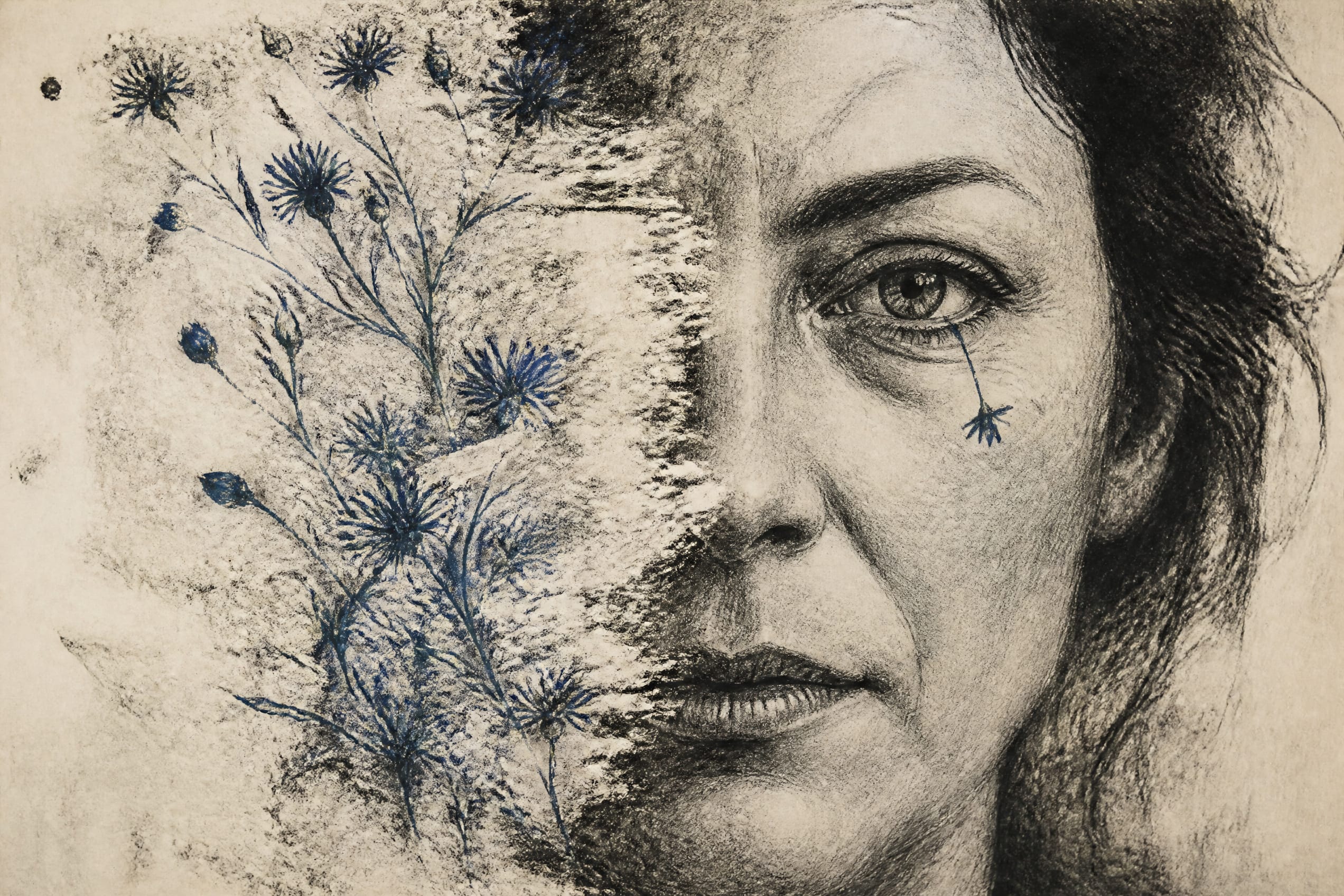
Every morning, Mara painted one flower beside the woman’s face.
She had stopped calling it a portrait months ago. Portraits were supposed to preserve people. This thing kept changing.
The first flower appeared where her mother’s cheek should have been—a small blue blossom growing from charcoal darkness. Mara blamed exhaustion. The second appeared three days later. By winter, thin stems had begun wandering through the unfinished half of the face, rooting themselves in smudges where Mara had erased and redrawn the same features dozens of times.
Her mother had been dead eleven years.
People liked to say grief faded. Mara suspected those people had confused fading with rearrangement. Grief was modular. It dismantled itself and reassembled whenever necessary. A song became a hand resting on your shoulder. Cinnamon became Christmas morning. An empty chair became an accusation. Some Tuesday afternoon, without warning, the way someone once pronounced your name could hollow out your chest.
So Mara stopped trying to finish the face.
She painted flowers instead.
Cornflowers for the blue dress her mother wore to Mara’s graduation. Chicory for the roadside where they once changed a tire together in the rain, laughing because neither knew what the hell they were doing. One tiny blossom beneath the eye for the afternoon Mara had discovered her mother crying in the kitchen and learned, for the first time, that mothers could break too.
That flower frightened her most.
Years passed.
The charcoal woman slowly disappeared beneath the garden until Mara could no longer tell where memory ended and invention began.
Then one morning Mara noticed something.
A single blue flower had grown downward from the woman’s eye.
She hadn’t painted it.
Mara touched the paper.
The charcoal stained her fingertip.
For reasons she couldn’t explain, she pressed that finger beneath her own eye and drew a thin black line down her cheek.
She understood then that kinship was not blood alone. It was inheritance of another kind—the gestures we unknowingly repeat, the stubbornness we swear isn’t theirs, the wounds handed down beside recipes and photographs, the laughter that escapes our mouths sounding disturbingly like someone who has been gone for years.
Mara looked at the unfinished woman.
For eleven years, she had believed she was painting her mother.
She finally understood.
Her mother had been painting her.
Discover more from Memoirs of Madness
Subscribe to get the latest posts sent to your email.


What an intriguing ending, Magnus. Well done.
LikeLiked by 1 person
Thank you, Fandango. I wanted that last turn to shift the meaning of everything that came before it. Mara thought she was preserving pieces of her mother, only to discover how much of her mother had been preserved in her. I’m glad the ending landed.
LikeLiked by 1 person
Beautiful!
LikeLiked by 1 person
Thank you! This one came from a quiet place—the idea that the people we’ve lost sometimes continue showing up in the smallest pieces of who we’ve become. I’m glad it connected with you.
LikeLike
It did, very much. Achingly so in fact. That bittersweet moment that stays, lingers, remembers.
LikeLike
A brilliant read Mangus
Thanks for joining in RDP 😀
LikeLiked by 2 people
Thank you! I had a good time finding my way into this one. Sometimes a prompt gives you a story; sometimes it opens a door you weren’t expecting to walk through. Thanks for giving me the excuse to wander through this one. 😀
LikeLiked by 1 person