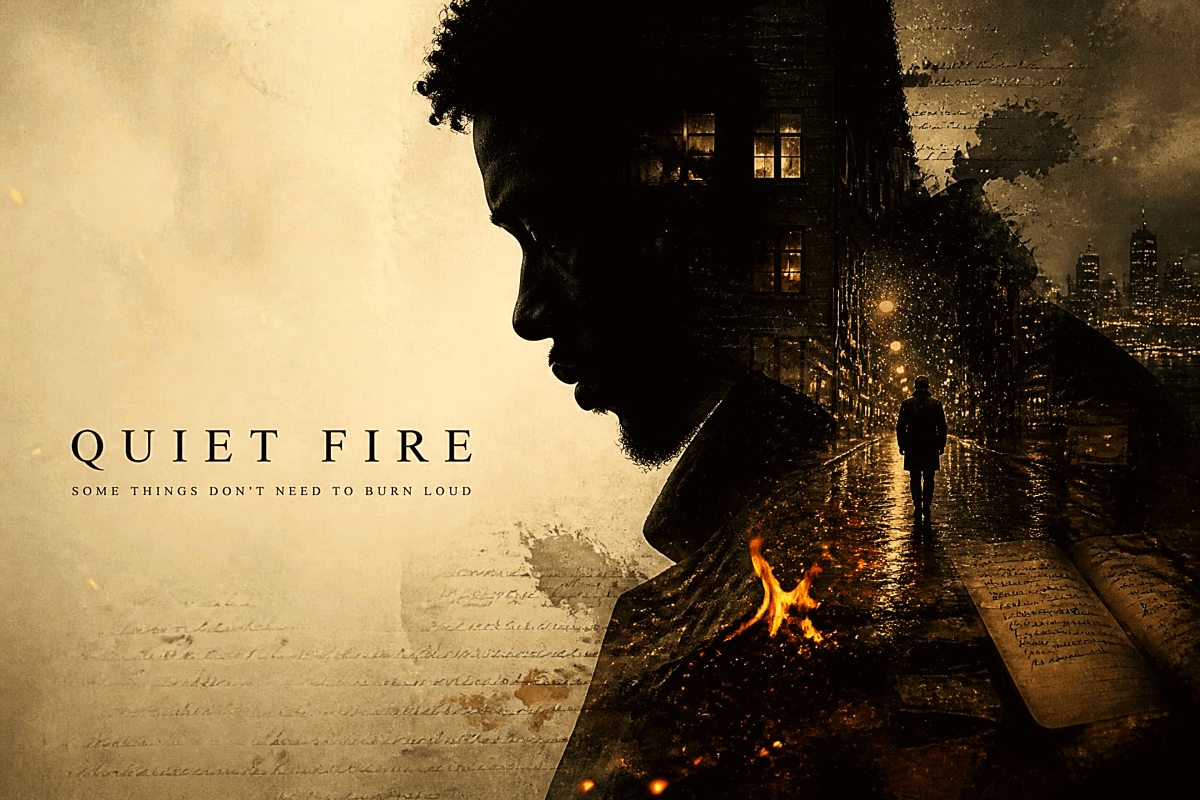
Quiet Fire — Entry 26:
Elias had walked home from Harlow’s Market every Thursday for nearly twelve years, though calling it a walk made it sound more intentional than it was. It was closer to a ritual, one of those small agreements a man makes with himself after life has taken enough liberties. He left his apartment at four-thirty, crossed Mercer Avenue before the buses thickened, stopped at the market for rye bread, eggs, coffee, and one Honeycrisp apple he never wrote on the list because pretending it was spontaneous gave the afternoon a little dignity. Mrs. Harlow rang him up without asking questions. Sometimes she told him the weather before it happened. Sometimes she pressed a dented can of soup into his bag because it was “about to expire,” though they both knew it had another year left and she simply worried about men who bought groceries like punctuation marks instead of meals. Elias accepted these small mercies with a nod, the way he accepted most things—carefully, quietly, and without giving anyone the satisfaction of seeing where they landed.
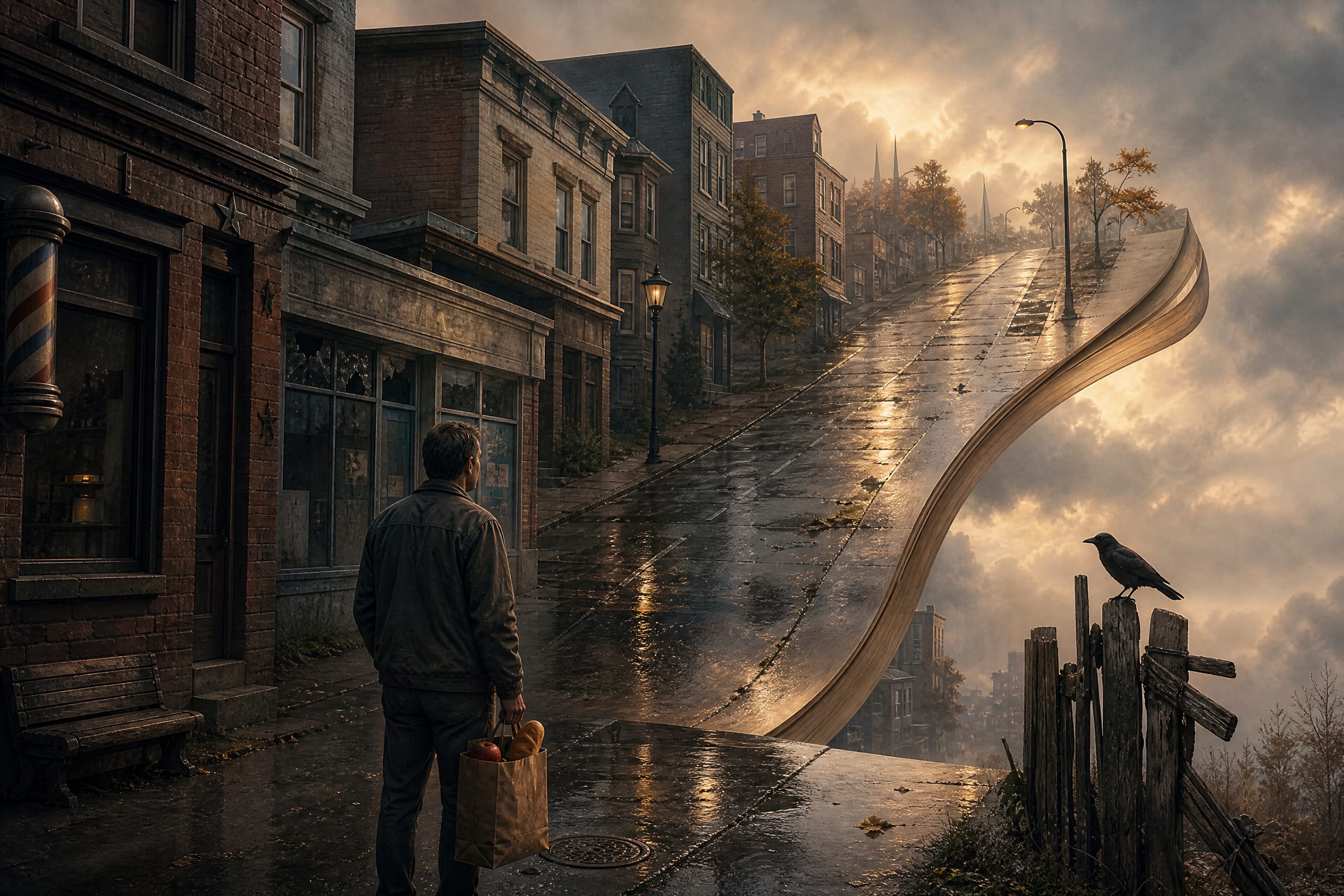
Routine had become his preferred form of architecture. It gave the days walls. It gave the hours doors. Without it, time became too open, and open things had a way of inviting memory inside. So he kept to his route. Harlow’s Market to the cracked green mailbox, mailbox to the old barber shop with the striped pole that no longer turned, barber shop to the abandoned pharmacy with sun-faded posters still promising flu shots from three winters ago, then down Tillman Street toward home. Same pavement. Same leaning lamppost. Same gum-darkened patch of sidewalk where some careless soul had made one bad decision that hardened into public record. He noticed these details not because they interested him, but because repetition had trained him to trust them. A man could survive almost anything if the street stayed where he left it.
That Thursday, the rye bread was still warm through the paper sleeve, and the apple rode heavy at the bottom of the grocery bag, bumping against his thigh with each step. The afternoon smelled of rain held back by stubborn clouds, exhaust from the avenue, and the yeasty warmth of the bakery two blocks over. Somewhere behind him, a delivery truck groaned into reverse, its warning beeps slicing the air with mechanical impatience. Elias adjusted the bag in his hand and turned past the barber shop, already thinking about coffee, toast, and the quiet half hour before evening news made the world sound determined to outdo itself.
Then the sidewalk shifted.
At first, Elias thought his knee had betrayed him. It had been known to do so since the winter he slipped outside the post office and refused help from three separate strangers because pride, unlike bone, never learned when to stop showing off. He paused, flexed his leg, and looked down. The concrete beneath his shoes was whole. No crack, no raised slab, no slick patch of moss. Yet something about the angle was wrong. The pavement ahead had lifted by maybe an inch, perhaps less, forming a soft upward curve where the street had always run flat. It was subtle enough to make accusation difficult. Too slight for alarm. Too visible to ignore.
He stood there longer than a reasonable man should stand over pavement.
The buildings on either side seemed to lean with the curve, not dramatically, not enough for anyone else to stop and point, but just enough that the brick faces of the pharmacy and laundromat appeared to have softened at their edges. Windowpanes held the afternoon light at odd slants. The painted letters on the pharmacy sign stretched thinner toward one end, as though the word itself had begun losing its grip. Elias blinked, then blinked again, waiting for ordinary geometry to reassert itself with the smug confidence it usually enjoyed.
It did not.
A woman passed him carrying a bouquet wrapped in brown paper, her heels clicking across the rising sidewalk without hesitation. She did not stumble. She did not glance down. A boy in a school uniform dragged one hand along the pharmacy wall and hummed to himself, his backpack bouncing as he climbed the gentle bend as naturally as if it had always been there. A dog trotted behind its owner, nose low, unconcerned by the fact that the street appeared to be considering escape.
Elias wanted to ask someone if they saw it too, but the question lodged in his throat. There were things a man could say in public, and there were things that invited people to look at him with professional kindness. He had seen that look before, though never directed at him. His mother had received it in the last year of her life whenever she insisted birds were gathering outside her window to count her breaths. The nurses had smiled softly and written things down. Elias had hated those smiles more than he hated the forgetting itself.
So he said nothing.
He stepped forward.
The incline met his shoe with a faint pressure, not unlike stepping onto the first board of an old dock and feeling it acknowledge his weight. The sensation traveled up through his ankle and into his chest, where it opened something small and unwelcome. For one impossible second, Elias had the feeling that the street recognized him. Not saw him. Not judged him. Simply knew the exact measure of what he carried and had lifted itself in response.
Ridiculous.
He walked faster.
By the time he reached the corner of Tillman, the pavement had returned to its expected flatness, or at least close enough that he could pretend his eyes had invented the rest. He did not look back. Looking back was how doubt became a room with furniture. He kept moving, grocery bag creaking in his fist, rye bread cooling, apple knocking gently against the carton of eggs like a little red heart refusing to keep still.
At home, he placed everything where it belonged. Bread in the tin box. Eggs in the refrigerator. Coffee beside the chipped mug he used every morning. The apple he set in the wooden bowl on the counter, though for reasons he could not name, he turned it stem-side up, as if proper orientation mattered.
The apartment greeted him with its usual disciplined silence. One chair at the kitchen table. One plate drying in the rack. One coat hanging by the door. He had spent years convincing himself that loneliness and order were not the same thing. Order was chosen. Loneliness merely arrived, hung its hat, and slowly learned where everything went.
He made toast. He boiled water. He sat at the table and tried to read the paper, but the print kept rearranging itself into the curve of that street.
After a while, he rose and crossed to the window. From his apartment he could not see the pharmacy or the bend, only the ordinary lower portion of Tillman Street where cars passed through puddles and people hurried home beneath umbrellas opening too late. Everything looked faithful. Everything looked fixed.
Still, long after night settled against the glass and the city softened into blurred lamps and wet tires, Elias found himself thinking about that slight lift in the pavement, that quiet refusal of the world to remain level, and beneath that thought, deeper and more troubling, another one waited with patient teeth.
Maybe the street had not changed at all.
Maybe it had simply become tired of pretending he hadn’t.
Elias slept poorly, though that in itself was hardly remarkable. Sleep had become less an act of surrender than a negotiation, a nightly exchange in which exhaustion promised rest while memory quietly rewrote the terms. He drifted through shallow dreams stitched together from familiar places that refused to remain familiar. Streets ended where rivers should have been. Doors opened into empty rooms he somehow recognized. Faces appeared with startling clarity until he reached for them, at which point they dissolved into light and shadow before leaving him alone with the peculiar certainty that someone had just left without saying goodbye.
Morning brought no answers, only coffee strong enough to convince his hands they belonged to him again.
He stood at the kitchen sink watching rain gather on the outside of the window. It arrived gently, soft enough that the city seemed to absorb it rather than resist it. Droplets wandered down the glass in uneven paths, merging with one another before disappearing beneath the frame. He found himself tracing their movement without realizing it, grateful for the simple honesty of gravity. Water always knew where to go.
Or at least it used to.
The thought arrived uninvited.
He frowned into his coffee.
The street occupied his mind far more than it deserved. He tried reading. The same paragraph escaped him four times. He turned on the radio only to switch it off moments later when the announcer’s cheerful certainty felt almost offensive. He considered calling his sister, but she would ask how he was doing, and he had grown tired of answering questions that sounded simple until someone expected the truth.
By late afternoon he found himself walking toward Harlow’s Market again without consciously deciding to leave the apartment.
The neighborhood smelled washed clean. Wet brick carried the mineral scent of old buildings drinking deeply after weeks of dry weather. The sycamores lining Mercer Avenue released the earthy fragrance of soaked bark, while somewhere nearby someone had begun grilling onions, their sweetness drifting lazily through the damp air. Tires whispered across rain-darkened pavement instead of roaring, and conversations seemed wrapped in soft cloth, their edges rounded by the weather.
Everything felt quieter.
Not silent.
Patient.
When the abandoned pharmacy came into view, Elias slowed instinctively.
The fold had grown.
It no longer resembled a flaw in the pavement. The entire street rose with graceful confidence, arching upward in a slow, impossible curve that seemed less constructed than remembered, as though the neighborhood had decided to reveal the shape it had always hidden beneath appearances. Storefronts leaned gently toward one another. Fire hydrants listed at improbable angles without spilling so much as a drop. Window reflections stretched upward, carrying clouds into places where clouds should never have existed.
He stopped beneath the old barber pole.
Rainwater trickled toward the center of the street.
Then, without hesitation, it changed direction.
Tiny silver streams gathered themselves and began climbing.
Not quickly.
Not dramatically.
Simply… upward.
The movement possessed the quiet inevitability of leaves floating downstream. It was so natural that for one disorienting heartbeat Elias wondered whether every river he had ever seen had flowed in the wrong direction instead.
He rubbed his eyes.
The water continued its ascent.
A quarter slipped from a young man’s pocket as he reached for his car keys. It struck the pavement with a bright metallic ring, spun twice, then rolled steadily toward the crest of the folded street before disappearing from sight. The young man never noticed. He climbed into his sedan, humming softly to himself, and drove away.
A newspaper page escaped a recycling bin farther down the block. Instead of tumbling through the gutter, it floated upward along the curve, turning lazy circles in the damp air before settling against the side of a lamppost halfway up the incline.
No one reacted.
A woman balanced two cups of coffee while chatting with her companion, laughing at something he couldn’t hear. A mail carrier adjusted the strap on his satchel and continued climbing the impossible grade with the practiced ease of someone delivering letters through perfectly ordinary terrain. Two teenagers argued about baseball while one absentmindedly bounced a tennis ball that obediently returned to his hand despite striking pavement tilted at an angle no physics teacher would tolerate.
Elias felt suddenly conspicuous.
Not because anyone watched him.
Because no one did.
It occurred to him that madness might begin exactly this way—not with dragons in the sky or voices beneath the floorboards, but with the unbearable loneliness of witnessing something the rest of the world accepted without question.
He stood perfectly still while life flowed around him like water navigating a stone.
Then he heard it.
A single caw.
Low.
Measured.
Not loud enough to startle.
Only enough to announce presence.
The crow perched atop the splintered fence bordering the abandoned lot beside the pharmacy.
Its feathers carried a blue sheen beneath the overcast sky, each one edged with rain that caught what little light remained. It regarded Elias with unsettling patience, head tilted ever so slightly, black eyes bright with the calm intelligence reserved for creatures that never felt obligated to explain themselves.
Elias had never believed the old stories.
Birds weren’t omens.
They weren’t messengers.
They were simply birds.
Yet something about this one resisted explanation.
The crow neither approached nor fled.
It waited.
As though time belonged to it.
A breeze wandered down the folded street carrying the smell of wet earth, rusted iron, and something older still—a scent like forgotten basements, unopened trunks, and books left too long in attics. Elias inhaled deeply before recognizing it.
It smelled like memory.
Not a particular memory.
The act of remembering itself.
His pulse slowed.
The neighborhood seemed to exhale around him.
Only then did he notice the words.
Someone had painted them across the weathered brick wall of the abandoned pharmacy in thick white letters that glistened faintly against the damp surface.
NOTHING HOLDS HERE.
The paint appeared fresh enough to still smell of solvent, yet rain had already begun washing pale trails through several of the letters, giving them the appearance of words attempting to leave the wall before anyone finished reading them.
Elias stepped closer.
He reached out almost involuntarily.
His fingertips brushed the rough brick.
The paint was dry.
The wall was warm.
Warmer than it should have been beneath an afternoon spent hidden behind clouds.
He left his hand there longer than necessary.
The bricks hummed with a barely perceptible vibration, so faint he couldn’t tell whether it belonged to the wall or to his own pulse echoing through bone.
Behind him, the crow called again.
Not impatiently.
Encouragingly.
Elias withdrew his hand.
The folded street rose before him in quiet invitation, curving gently toward a horizon that should not have existed.
For the first time since noticing the impossible bend, he found himself wondering a question that frightened him more than any answer ever could.
What if the street wasn’t asking him to believe it?
What if it had simply been waiting for him to stop pretending he couldn’t see it?
Elias stood at the foot of the folded street until the last of the afternoon surrendered to evening. The neighborhood continued around him with the quiet confidence of a world that had no interest in proving itself. A city bus sighed to a stop two blocks away. Somewhere, a screen door slapped shut, followed by the distant laughter of children chasing one another through sprinklers. The ordinary rhythms of the day persisted without interruption, each sound settling naturally into the next, yet everything seemed to arrive from a slightly different direction than it should have, as though the air itself had developed a gentle inclination toward the impossible.
He looked once over his shoulder.
The road behind him stretched perfectly flat, disappearing between familiar houses washed in the amber light of early evening. It would have been easy to turn away. Easy to return home, make coffee, convince himself that fatigue had become a more persuasive storyteller than reality. He imagined tomorrow arriving exactly as yesterday had, the folded street dismissed as a trick of light, an overworked mind, or the harmless eccentricity of growing older. There was comfort in those explanations. Comfort, he had learned, often came dressed as certainty.
But certainty had become strangely heavy.
The grocery bag slipped lower in his hand. He tightened his grip, feeling the paper soften where the rain had dampened it. The warmth from the loaf of bread had long since faded. The eggs shifted quietly against one another, delicate enough to remind him that some things survived only if carried with care.
He drew a slow breath and stepped onto the incline.
The pavement yielded beneath his shoes with the quiet resilience of earth after spring rain. It wasn’t unstable. If anything, it felt more solid than the streets below, as though this impossible curve rested upon foundations deeper than the city itself. Each step carried him upward without resistance, and with each step something inside him seemed to loosen—a knot untied so gradually he hadn’t realized it had been there.
The air grew lighter.
Not thinner.
Lighter.
The familiar ache in his lower back, the stiffness that greeted him every morning before coffee, diminished until he found himself walking without the cautious calculation age had quietly demanded of him. Even the grocery bag felt less burdensome, swinging easily beside his leg as though gravity had agreed to carry part of its weight.
He paused and looked down.
The city stretched beneath him at an angle no architect would ever approve, rooftops folding gently into one another like overlapping pages in a well-read novel. Chimneys leaned toward church steeples. Telephone wires traced graceful arcs across the sky instead of rigid lines. The rain that had collected in gutters below shimmered upward in slow silver ribbons before dissolving into mist halfway to the crest.
Nothing appeared broken.
Only rearranged.
The scent of wet asphalt gradually surrendered to something older.
Fresh-cut cedar.
Pipe tobacco.
Black coffee cooling on a winter windowsill.
His father’s workshop.
The realization stopped him more effectively than any fear.
He hadn’t thought about that smell in decades.
His father had built furniture in a narrow garage behind their first house, humming tunelessly while curls of cedar drifted across the concrete floor like pale ribbons. Elias remembered standing in the doorway, too young to be useful, holding nails he wasn’t trusted to hammer. His father never spoke much while he worked, yet the silence between them had always felt full instead of empty.
The memory arrived with astonishing clarity.
Then it was gone.
Another scent took its place.
Lavender soap.
His mother’s linen closet.
Freshly ironed shirts hanging in careful rows.
A summer afternoon when she had laughed so hard over something trivial that tears ran down her face while his father pretended to be annoyed simply to hear her laugh again.
Elias closed his eyes.
He had spent years believing memory faded like old photographs.
Instead, it seemed to wait.
Patiently.
For the right road.
The crow landed several yards ahead without making a sound.
It turned once, meeting his eyes before hopping farther up the incline. It did not beckon. It did not hurry him. It simply moved with the quiet assurance of something that already knew where the journey ended.
Elias found himself following.
The folded street grew steeper, though climbing required no greater effort. Houses gradually gave way to stretches of open pavement where familiar storefronts dissolved into long reflections that possessed no obvious source. Windows held images that belonged to different seasons. One displayed autumn leaves swirling across a porch he recognized from childhood. Another reflected snowfall despite the warm July evening surrounding him. Somewhere, faint music drifted through the air—a piano playing a melody he almost remembered from years ago, stopping just before recognition could settle into certainty.
He realized then that the street wasn’t changing around him.
It was changing with him.
Each step uncovered something he had carried so long it had become invisible.
The conversation where he chose caution over honesty.
The letter he never mailed because too much time had passed.
The job he accepted because it was practical instead of meaningful.
The woman who had once asked, “What would you do if you stopped being afraid?” and whose face he could still recall more vividly than his answer.
Regret, he discovered, rarely announced itself in dramatic moments.
It accumulated quietly inside ordinary decisions.
A thousand small retreats eventually disguised themselves as a life.
The realization hurt.
Not sharply.
Deeply.
Like discovering an old fracture had never truly healed.
Ahead, the crow took flight.
Its wings caught the fading light before disappearing into the bright haze gathering near the crest.
Elias continued climbing until he noticed movement farther up the impossible curve.
Someone walked there.
The figure moved with an ease that felt almost musical, each step flowing naturally into the next, shoulders relaxed, head lifted toward the widening sky. A faded canvas jacket shifted gently with the evening breeze.
The same jacket Elias had worn for years.
The same silver beginning to thread through dark hair.
The same slight limp from an ankle broken decades earlier outside the post office on an icy February morning.
He stopped.
The figure did not.
Instead, the stranger paused beside an elderly woman struggling with two heavy grocery bags. Without hesitation, he accepted one, smiled, and matched her pace until she reached level ground. They exchanged a few words carried away by the wind before parting with the easy warmth shared by people who still believed strangers belonged to one another.
The man continued walking.
A little farther on, he stopped to straighten a child’s fallen bicycle.
Then he laughed at something the child said.
The sound drifted down the folded street.
Warm.
Unforced.
Familiar enough to tighten something in Elias’s chest.
He realized, with a quiet certainty that required no explanation, he was listening to his own laugh.
Not the careful chuckle he offered coworkers or cashiers.
The laugh he had not heard from himself in years.
The one that arrived before disappointment learned how to interrupt it.
The stranger never once looked back.
He simply kept walking toward the crest where sky and pavement dissolved into one another beneath a wash of golden light.
Elias watched him go.
Not with envy.
Not anymore.
But with the bittersweet recognition reserved for meeting someone you once promised never to abandon.
And slowly, almost imperceptibly, he understood.
The man ahead of him was not the life he had lost.
He was the part of himself that had refused to stop walking.
Elias stood on the folded street for a long while after the other man disappeared beyond the crest. He did not chase him. He did not call his name. The impulse rose briefly, no stronger than the urge to wave at a departing train, then settled into something quieter. There are moments in a life that refuse interruption. To pursue them is to misunderstand them. Whatever waited beyond that impossible horizon belonged to another journey, another season of becoming. This one still belonged to him.
The evening gathered around the neighborhood with unhurried grace. The western sky surrendered its gold to muted violet, and the first porch lights awakened one by one below him, their warm squares of amber punctuating the deepening dusk. Somewhere in the distance, a screen door closed with the familiar report of old wood meeting old wood. A dog barked twice, was answered by another several blocks away, and then the city settled into the gentle murmur reserved for people returning home.
Home.
The word felt unexpectedly unfamiliar.
Not because he had forgotten where he lived, but because he could no longer remember when he had stopped thinking of it as a place he inhabited and started thinking of it as somewhere he simply waited.
A breeze wandered across the crest of the folded street, carrying with it the scent of honeysuckle, damp earth, and freshly cut grass from some unseen yard. It brushed against his face with surprising tenderness, like the absentminded touch of someone passing through a room who still remembered you were there. He closed his eyes, allowing the cool air to settle against his skin.
For the first time in years, he noticed that his shoulders no longer ached.
Not because the pain had vanished.
Because he had stopped bracing against it.
He opened his eyes.
The impossible street remained before him, but something about it had softened. The sharp certainty of its upward arc seemed to relax at the edges, as though it had completed the work it had quietly begun long before Elias had ever noticed the first bend in the pavement. The buildings no longer leaned quite so dramatically. Reflections found their proper homes inside windows. The silver streams of rainwater, which only moments earlier had climbed effortlessly toward the crest, hesitated, shimmered, and slowly surrendered to gravity once more.
The world wasn’t correcting itself.
It was exhaling.
Elias began the walk back down.
Each step carried a curious sensation, not of descending but of returning. The folded pavement yielded gently beneath his shoes, releasing him in measured increments. The neighborhood unfolded around him with quiet familiarity. Brick regained its ordinary geometry. Telephone poles straightened. Shadows resumed their patient obedience to the setting sun. Somewhere below, a bicycle bell rang with cheerful insistence, and this time the sound arrived exactly when it should.
Halfway down the incline, he paused.
The weathered brick wall of the abandoned pharmacy stood beside him.
He searched for the painted words.
The wall was bare.
Rain-darkened mortar filled the spaces between old bricks worn smooth by decades of weather, but there was no trace of white paint, no ghost of letters, no stain left behind by a hurried brush. He reached out, resting his fingertips against the warm brick exactly where the message had been.
Only rough stone greeted his hand.
He smiled.
Not because he understood.
Because he no longer needed to.
By the time he reached the bottom of the street, nothing remained to suggest that the neighborhood had ever defied the ordinary. Cars rolled across level pavement. A delivery driver balanced three pizzas with practiced confidence. Children chased one another across the sidewalk, their sneakers slapping the concrete with joyful disregard for the invisible mathematics that kept the world beneath them. The folded street had become just another street.
Or perhaps it always had been.
The crow remained.
It perched atop the same splintered fence, feathers catching the last threads of evening light. It regarded Elias for a quiet moment before lifting effortlessly into the air. The bird circled once above the intersection, then drifted westward until it dissolved into the darkening sky.
Elias watched until there was nothing left to follow.
The walk home felt strangely shorter.
The grocery bag rested comfortably in his hand, no longer pulling at his shoulder with familiar insistence. The rhythm of his footsteps found an ease he hadn’t realized had been missing. He noticed things that had escaped him for years: the jasmine climbing Mrs. Ortega’s fence, the uneven laughter spilling from the upstairs apartment above the laundromat, the warm glow of the bakery window where a young baker dusted flour from his apron before locking the door for the night.
How long had those things been waiting for him to look up?
Inside his apartment, the familiar silence welcomed him, though it no longer felt quite as empty. He unpacked his groceries with the same practiced motions that had begun every Thursday evening for more than a decade. The rye bread found its place inside the tin box. The eggs settled carefully into the refrigerator door. The coffee joined its place beside the chipped enamel mug whose handle had survived two apartments, one marriage, and countless mornings that had blurred together until they seemed like a single endless day.
He reached into the paper bag for the apple.
His hand found nothing.
He frowned and peered inside.
Empty.
A soft tap echoed somewhere behind him.
He turned.
The Honeycrisp rested in the middle of the kitchen floor.
For a moment it remained perfectly still.
Then, almost imperceptibly, it began to move.
It rolled across the worn hardwood with patient determination, tracing a gentle curve that ignored the subtle slope toward the sink. The polished red skin caught the amber light from the overhead fixture as it traveled, not quickly, not mysteriously, but with the quiet confidence of something that already knew where it belonged.
It came to rest against the front door.
Elias looked from the apple to the brass knob above it.
Outside, the evening breathed softly through the cracks around the frame. Somewhere beyond the building, leaves whispered together beneath a rising wind. Farther away, a train announced its departure with a low mournful horn that lingered over the rooftops before dissolving into the night.
He thought about the man on the folded street.
Not the life he might have lived.
The life he still possessed.
He thought about the letter folded inside the top drawer of his desk, written months ago and never mailed because he had convinced himself too much time had passed. He thought about the sketchbook tucked away in the back of his closet beneath old tax returns and forgotten instruction manuals. He thought about the phone numbers he had memorized long ago and stopped dialing for reasons that had seemed sensible at the time.
Routine had protected him.
It had also become a room with no windows.
The apple waited.
So did the door.
Elias bent slowly, picked up the fruit, and smiled at the cool weight of it resting in his palm. He reached for the doorknob, hesitated only long enough to listen to the steady beat of his own breathing, then opened the door to the cool evening air.
The city stretched before him exactly as it always had.
Streetlights glowed.
Neighbors talked across porches.
Somewhere, laughter drifted through the darkness.
Nothing looked different.
Yet as he stepped outside, he could not shake the quiet feeling that the world had not become larger.
Only his place within it.
Behind him, the apartment stood open for another heartbeat before he reached back, left the door unlocked, and walked into the evening with the apple in one hand and both hands finally free.
Discover more from Memoirs of Madness
Subscribe to get the latest posts sent to your email.

