
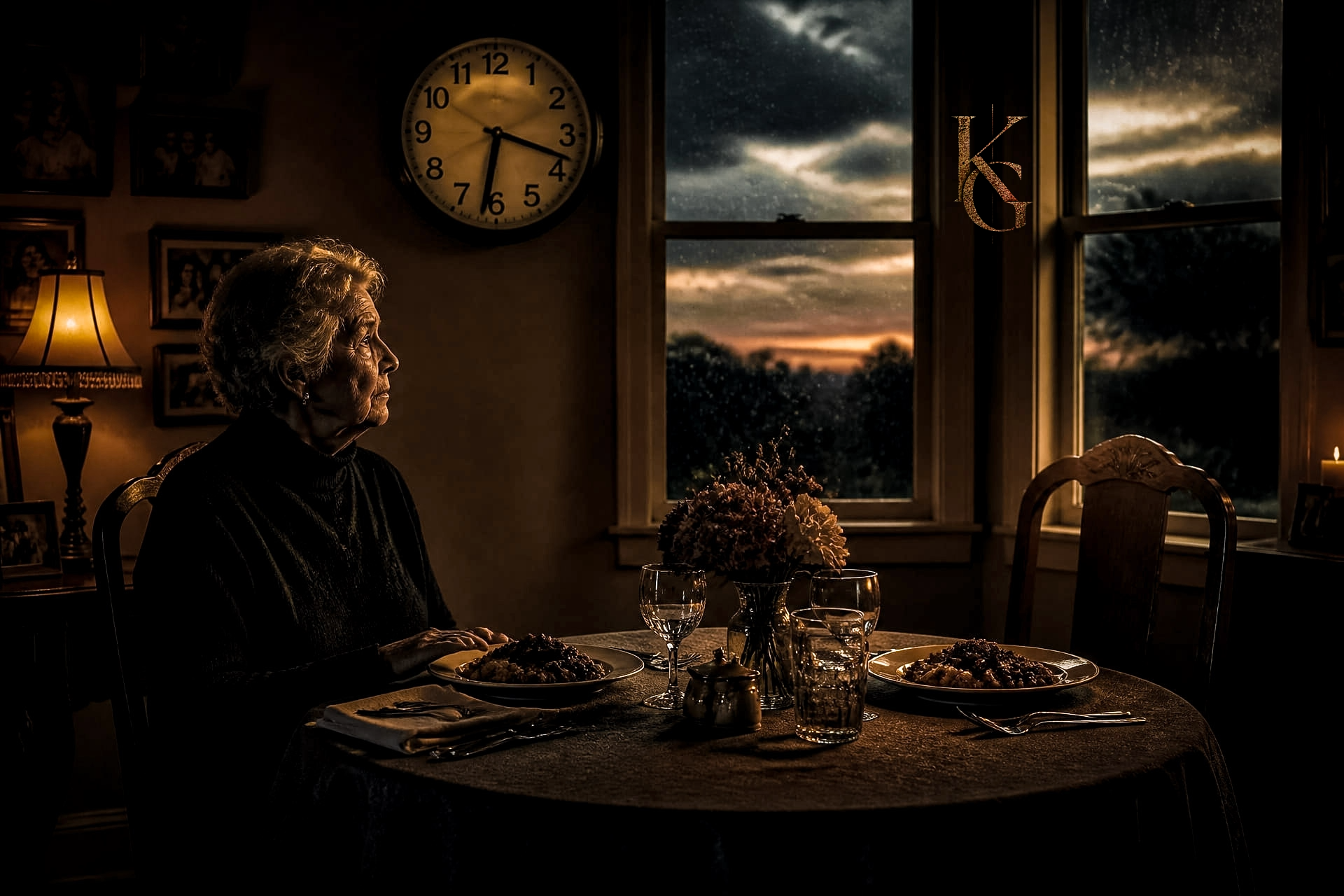
Every evening at exactly 6:17, Eleanor Whitaker set the table for two, not because she expected company and certainly not because she enjoyed explaining the habit to people who mistook it for loneliness, grief, or the early stages of mental decline. The truth was more troublesome than any of those explanations because it lacked a reasonable shape. Reasonable things could be examined, categorized, and eventually dismissed. This ritual refused to cooperate. It had survived the death of her husband, the departure of her children, three changes of address, two surgeries, and enough years to turn memories into artifacts. Somewhere along the way, the act of placing a second plate on the table stopped feeling like a choice and became something closer to an obligation, as though abandoning it might disrupt a promise she did not remember making.
The house had grown quieter with age, though Eleanor often suspected the silence possessed a weight of its own. Some evenings it settled around her shoulders like a blanket. Other nights it pressed against the walls and watched from corners. The old farmhouse had witnessed births, arguments, reconciliations, holidays, funerals, and the slow erosion of time itself. The hardwood floors carried scars from furniture that no longer existed. The kitchen cabinets held cups belonging to people long buried. Even the air seemed crowded with the residue of vanished conversations. Eleanor spent most of her days alone, yet she rarely felt solitary. The past occupied too much space for that.
Her children worried about her. They disguised their concern behind casual questions and cheerful smiles, but Eleanor recognized the look. She had worn it herself while caring for aging relatives years earlier. It was the expression people adopted when they were trying to determine whether a loved one was becoming forgetful or simply old. She could almost hear their private conversations after each visit. Mom still sets the table for two. Mom still talks about that chair. Mom swears she isn’t waiting for anyone. Their concern annoyed her, not because it was unreasonable, but because she occasionally shared it. There were mornings when she stood at the kitchen sink with a cup of coffee warming her hands and wondered whether she had spent the better part of forty years nurturing a delusion.
Yet every evening, as the minute hand crawled toward 6:17, the uncertainty returned. It arrived not as a thought but as a sensation, a subtle tightening beneath her ribs, the feeling a person experiences moments before an expected knock at the door. She had never been able to explain it. The chair across from her never felt empty. Vacant perhaps. Unoccupied certainly. But not empty. Empty implied nothing belonged there. Eleanor had spent decades carrying the unsettling conviction that something did.
The evening the stranger arrived began like hundreds before it. Rain drifted across the windows in thin silver lines while thunder rolled lazily beyond the distant hills. The house smelled of beef stew simmered for hours, fresh bread cooling on the counter, and the faint scent of old wood warmed by lamplight. Outside, the fields dissolved into shadows beneath a sky bruised purple and charcoal by the approaching storm. Inside, the clock continued its patient ticking, measuring seconds with the indifference only old machines possess.
Eleanor lowered herself into her chair and stared at the second place setting. The bowl across from her released thin ribbons of steam into the air. The spoon rested neatly beside the folded napkin. Everything appeared exactly as it had appeared the night before and the night before that. She should have felt comforted by the familiarity. Instead, an inexplicable unease settled over her. The room felt different. Not changed exactly. Expectant.
The old clock struck 6:17.
A knock echoed through the house.
The sound was not loud, yet it landed with enough force to stop her breath. For a moment she remained perfectly still, listening to the rain tap softly against the roof. The knock came again. Three measured raps. Patient. Certain. The kind of knock delivered by someone who already knew the door would open.
As Eleanor rose from her chair, a thought surfaced from somewhere deep within her mind, a thought so unexpected it nearly made her laugh.
He’s finally here.
The idea was absurd.
She didn’t know who he was.
She didn’t know why she thought of the visitor as a man.
She didn’t even know why the certainty felt older than memory itself.
Yet by the time she reached the front door, her heart was pounding hard enough to shake loose ghosts she had spent decades burying.
When she opened the door, the stranger standing on the porch looked less like a miracle and more like a man who had lost several fights with life and somehow survived anyway.
Discover more from Memoirs of Madness
Subscribe to get the latest posts sent to your email.


Compelling story, Mangus.
LikeLike
OMG I so love this! It reminds me very much of sixth sense (in a sense) but more….so much more! tyvm. I very much enjoyed this!
LikeLike
Another good piece Mangus
LikeLike