The first letter arrived on a Tuesday morning, although Marianne could never later identify the precise moment it appeared. One instant the kitchen table held nothing more unusual than a cooling mug of coffee, a folded newspaper, and the quiet evidence of another ordinary day, and the next there was an envelope resting neatly in the center of the table as though it had always belonged there. At first she assumed she had overlooked it, because that was what sensible people did when confronted with something strange. They searched for explanations before accepting mysteries. Age had taught her that memory was an unreliable companion, forever misplacing details and rearranging events to suit its own purposes. Yet the moment she picked up the envelope, a faint unease settled into her chest. The paper felt old beneath her fingertips, softened by time and repeated handling, and the handwriting on the front struck her with an unsettling familiarity she could not immediately place.
She carried the envelope to the window where the morning light was stronger, and as soon as she looked more closely, recognition arrived like a stone dropped into still water. The handwriting belonged to her. Not the handwriting she used now, cramped slightly by arthritis and years of hurried notes scribbled on grocery lists and appointment reminders, but the handwriting she had possessed decades earlier when the future still seemed expansive and possibility stretched endlessly before her. The letters were confident, elegant, and unhurried. They belonged to a woman who still believed life would unfold according to plan. Marianne stared at her own name written on the envelope and felt a chill despite the warmth of the room. There was no stamp, no return address, and no indication of how it had entered a locked house occupied by a woman who lived alone. Inside she found a single sheet of paper containing only three short sentences.
Do not forgive him.
No matter what he says.
Please listen to me this time.
For several minutes she sat motionless at the table, reading and rereading the words while her coffee slowly lost its heat. Eventually she laughed, not because anything about the letter was amusing, but because laughter offered a fragile defense against fear. By noon she had convinced herself someone was playing an elaborate joke. By evening she had nearly succeeded in believing it. The second letter arrived two days later inside a cookbook she had not opened in years. The third appeared on her bedside table. The fourth waited beneath a stack of folded towels in the linen closet. Every envelope carried the same handwriting. Every letter ended with the same signature.
Love, Marianne.
As the days passed, the messages became increasingly personal. They referenced memories she had not revisited in decades and details she had never shared with another living soul. One letter reminded her of the scar hidden behind her left knee, a thin white line left behind after a bicycle accident when she was eleven years old. Another described the exact words her mother spoke during their final conversation before cancer claimed her. A third recalled a miscarriage she had never told anyone about, not even her husband. Reading the letters felt less like receiving correspondence and more like having portions of her own mind returned to her piece by piece. The pages seemed to know her better than she knew herself, reaching into forgotten corners of memory and illuminating moments she had carefully stored away beneath years of routine and survival.
Sleep abandoned her shortly afterward. She found herself wandering through the house at odd hours, checking doors and windows, searching for signs of intrusion, attempting to construct a rational explanation for events that refused to behave rationally. Yet the letters continued arriving. They accumulated on tables, shelves, countertops, and chairs until the house began to resemble an archive devoted entirely to her life. Some contained warnings. Others contained memories. A few appeared almost desperate, as though the writer feared time was running out. Marianne read every one of them, despite knowing they unsettled her, because each letter carried the intoxicating possibility that the next page might finally explain what was happening.
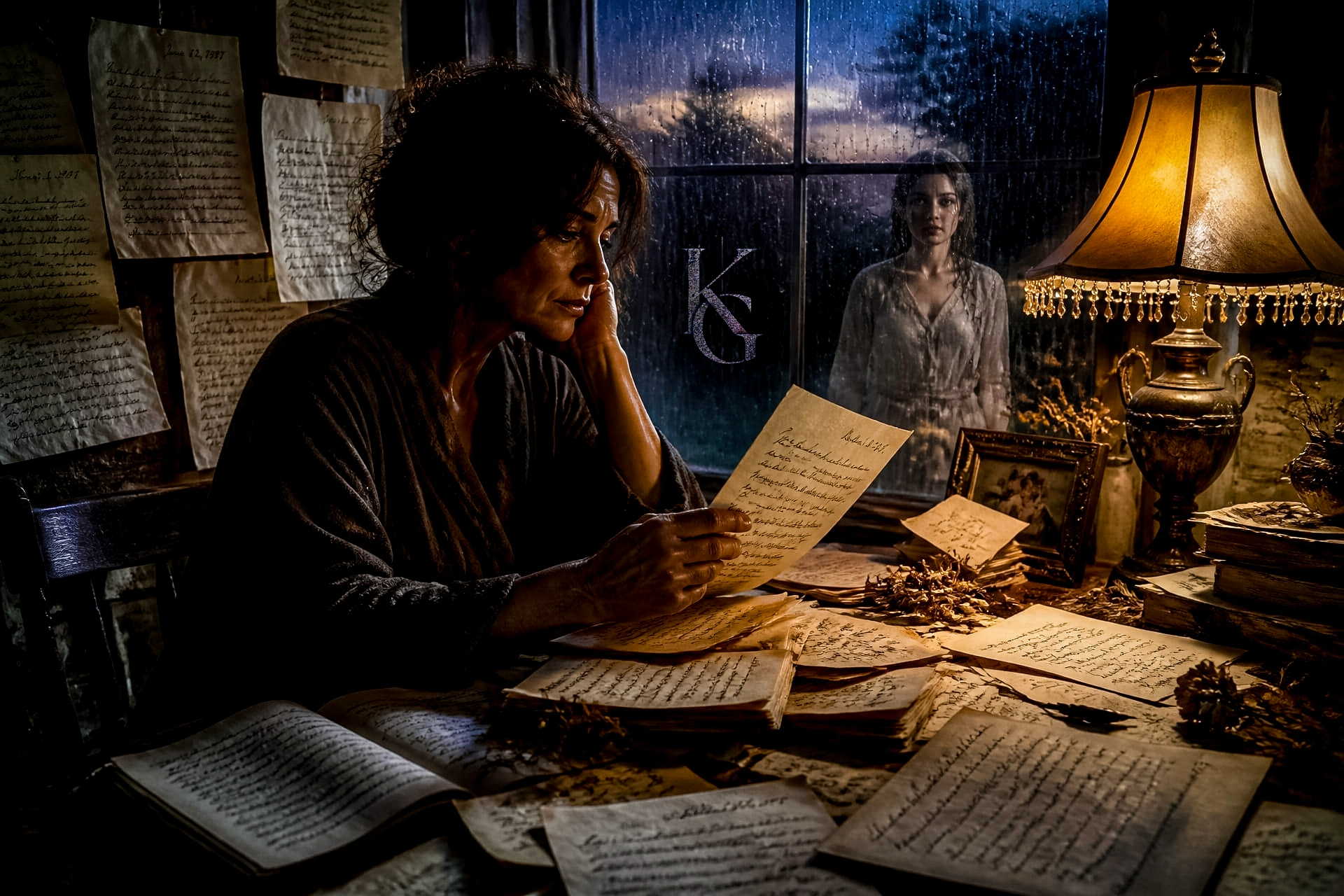
The first time she noticed the young woman outside the window, a storm had settled over the town, turning the evening sky into a restless sea of dark clouds and silver rain. Marianne had been sitting at the dining room table sorting through another stack of letters when she happened to glance toward the glass. There, beyond the rain-streaked window, stood a young woman wearing a pale dress that clung damply to her frame. She appeared to be no older than twenty. Water streamed through her dark hair and traced pale paths across her face. At first Marianne thought someone had become lost during the storm and sought shelter. Then she looked closer. The resemblance was impossible to ignore. The eyes. The shape of the mouth. The posture. It was not merely a woman who looked like Marianne. It was Marianne, or at least some younger version of her standing silently in the rain.
The figure never knocked on the door. She never moved. She simply stood there watching. Marianne blinked and the woman vanished. The following night she appeared again. Then the night after that. Always standing beyond the glass. Always watching with an expression Marianne could not quite decipher. There was sadness in it, certainly, but something else as well. Disappointment perhaps. Or grief. It was the look of someone witnessing a mistake they were powerless to prevent.
As the appearances continued, the letters grew increasingly urgent. Again and again they returned to the same warning.
Do not forgive him.
The identity of the man seemed obvious. Richard. Her ex-husband. The man who had spent years turning apologies into a form of manipulation. The man whose betrayals had become so frequent that she eventually stopped being surprised by them. The man she had left after discovering that endurance and love were not the same thing, no matter how desperately she wished they were. Three decades had passed since the divorce. Three decades without hearing his voice. Three decades during which she convinced herself she had moved on.
Then the phone rang.
His voice sounded older. Softer. Time had stripped away the arrogance she remembered and replaced it with something gentler. Or perhaps she merely wanted to believe it had. He spoke about regret. About mistakes. About age. He spoke the language people often learn when they begin to recognize how little time remains. Against her better judgment, Marianne agreed to meet him.
The letters became frantic afterward.
You already know who he is.
You already know what happens.
Please listen.
Yet as she sat across from Richard in a small café filled with the smell of coffee and baked bread, Marianne found herself remembering not the betrayals but the years before them. Memory had always been selective. It polished certain moments while allowing others to fade. She remembered laughter. Road trips. Shared dreams. She remembered the man she thought he was before life revealed the man he actually became. Loneliness whispered persuasive arguments in moments like these. It suggested that people changed. It suggested that forgiveness was noble. It suggested that old wounds deserved another chance to heal.
After their meeting, she returned home to find another letter waiting on the kitchen table.
This one contained only two words.
Too late.
That night she dreamed of the girl in the rain. For the first time, the young woman spoke.
“Why do you keep abandoning me?”
Marianne awoke before dawn, her heart hammering against her ribs. The question lingered long after the dream dissolved. She wandered downstairs and discovered something impossible. The walls of the dining room were covered with letters. Thousands of them. Every surface buried beneath page after page of familiar handwriting. The sight stole the breath from her lungs. Some letters appeared decades old. Others seemed freshly written. Dates stretched backward and forward across years she had lived and years she had not yet reached.
As she read, a horrifying realization slowly emerged.
The letters were not all written by the same Marianne.
Some came from versions of herself who had made different choices.
Some came from futures that had not yet happened.
Some came from women who sounded older, wearier, and far more broken than she felt now.
Yet all of them shared the same desperate purpose.
All of them were trying to prevent something.
Marianne continued reading until her hands trembled. One letter described forgiving Richard. Another described trusting a business partner who later destroyed her finances. Another described reconnecting with an old friend who betrayed her confidence. The details changed. The names changed. The circumstances changed.
The outcome never did.
Again and again she found herself confronted by the same painful truth.
The letters were never warning her about a specific man.
They were warning her about a pattern.
A lifetime spent mistaking self-sacrifice for virtue.
A lifetime spent convincing herself that understanding someone else’s pain required accepting her own.
A lifetime spent forgiving everyone except the person who deserved her loyalty most.
The final letter lay alone on the table.
Unlike the others, it contained no warning.
Only a question.
When did you decide your instincts were less trustworthy than everyone else’s?
Marianne stared at the words until tears blurred the ink. Outside, rain tapped softly against the window. She looked up.
The young woman stood there once more.
For the first time, Marianne truly saw her.
Not a ghost.
Not a hallucination.
Not a visitor from the past.
She was the version of Marianne who still trusted herself. The version who recognized danger when she saw it. The version who knew that kindness without boundaries eventually becomes self-destruction. The version left standing outside every time Marianne chose comfort over truth.
Slowly, Marianne gathered the letters into a single pile and carried them to the fireplace. The pages ignited easily, flames consuming decades of warnings while shadows danced across the room. She watched until every sheet collapsed into ash. The house felt strangely lighter afterward. Quieter. As though a conversation that had lasted a lifetime had finally ended.
Hours later, she stood alone in the bathroom preparing for bed. Exhaustion weighed heavily on her shoulders. The events of the evening already felt dreamlike, impossible to reconcile with the ordinary reality she had inhabited only weeks before. She brushed her teeth, rinsed the sink, and glanced into the mirror.
Her breath caught.
Someone stood behind her.
Not the girl.
Not Richard.
Not a stranger.
An older version of herself.
Far older.
The woman’s face carried the accumulated weariness of decades Marianne had not yet lived. Deep lines framed her eyes. Her shoulders sagged beneath invisible burdens. Most unsettling of all was the expression she wore.
Recognition.
As though she had seen this moment countless times before.
As though this conversation had been repeating forever.
The older woman slowly raised a single envelope.
Marianne stared at her reflection.
The envelope was addressed to tomorrow.
Discover more from Memoirs of Madness
Subscribe to get the latest posts sent to your email.
 Memoirs of Madness
Masterful piece Mangus.
LikeLike