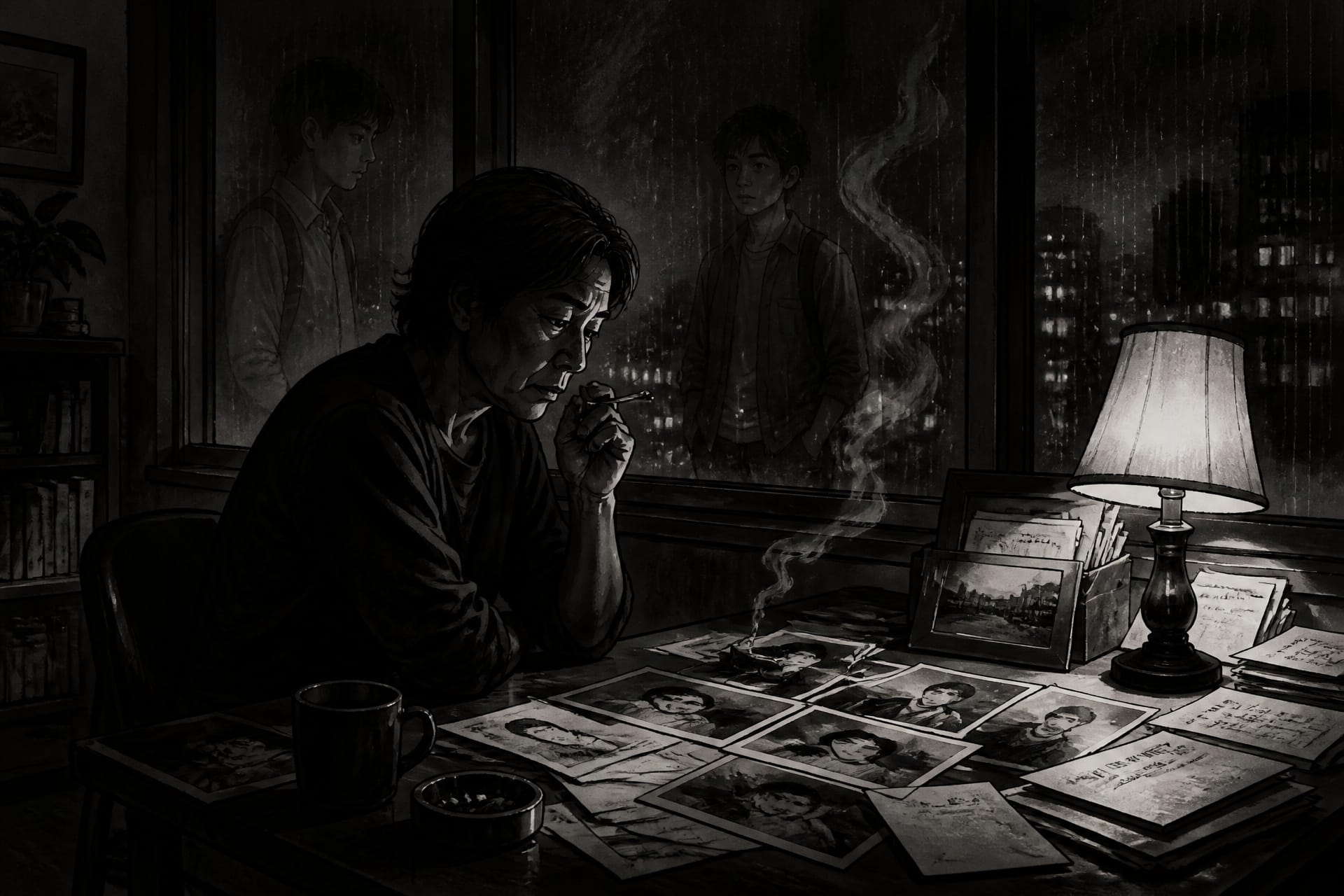
Rain drifted down the apartment windows in wavering silver lines, distorting the city beyond into a landscape of smeared light and shadow. The buildings across the street appeared to dissolve and reform whenever a passing car cast its headlights through the storm, as though the world outside existed only as a rough approximation of itself. Ellen had been watching the rain for nearly an hour before she realized she had not turned a single page of the book resting open beside her. The apartment had grown increasingly quiet since Marcus died three months earlier, and she was beginning to understand that silence was not the absence of sound but the presence of something else entirely. It lingered in rooms. It settled into furniture. It occupied the spaces where conversations used to live.
The shoebox sat open on the dining room table beneath the yellow glow of a lamp that Marcus had always hated and she had always defended. The cardboard was stained with age and softened at the corners from years of handling. Dust clung to its edges. When she had discovered it earlier that afternoon behind a row of winter coats in the back of his closet, she had almost ignored it. There had been so many things to sort through since the funeral that another forgotten box seemed insignificant. Yet something about its placement had bothered her. It had not merely been stored away. It had been hidden.
Over the course of twenty-two years of marriage, Ellen had developed an almost embarrassing confidence in how well she knew her husband. She knew which songs would make him stop talking and listen. She knew he took his coffee black when he was worried and with cream when he was content. She knew that he rubbed the scar on his wrist whenever he was lying, and that he cried during documentaries when he believed no one was looking. She had built an entire understanding of her life upon the assumption that there were no significant corners of Marcus left unexplored.
The shoebox suggested otherwise.
Inside were photographs.
Dozens of them.
Not family photographs. Not vacation photographs. Not forgotten snapshots from some youthful adventure he had neglected to mention. Every image contained the same boy. At first glance he appeared unremarkable: dark hair, thin shoulders, serious eyes. Yet the longer Ellen studied the photographs, the more unsettled she became. The boy appeared at different ages throughout the collection, sometimes eight or nine years old, sometimes approaching adulthood, yet always wearing the same expression. It was not sadness exactly. It was the look of someone expecting something terrible to happen and slowly realizing that it already had.
More disturbing was the feeling that she recognized him.
Not from memory.
From somewhere deeper.
The sensation was similar to waking from a dream and carrying the certainty that someone had been standing beside your bed, even though you could not remember their face.
She picked up one of the photographs and turned it over. On the front, the boy stood beside a lake beneath a bright summer sky. The water glittered behind him, frozen forever in a moment that should have felt ordinary. On the back, written in Marcus’s unmistakable handwriting, were three words.
HE FELL IN.
Ellen stared at the note for several moments before returning her attention to the image itself. The longer she looked, the more she became aware of a peculiar sensation traveling through her fingertips. The photograph felt warm. Not warm from being held. Not warm from the lamp shining overhead. It possessed its own heat, subtle but undeniable, as though it had been resting in sunlight moments before she found it.
A faint unease settled into her stomach.
She told herself there was a rational explanation.
Old paper reacted strangely to temperature.
Grief distorted perception.
Loneliness created patterns where none existed.
The photograph remained warm.
Then the boy blinked.
For several seconds Ellen did not move. She sat perfectly still while her mind searched desperately for alternatives. Fatigue. Stress. An involuntary twitch in her eye. Anything except what she believed she had seen. Yet even as she attempted to reason with herself, the image continued to change. Tiny ripples spread across the lake behind the boy. A breeze stirred the hair resting against his forehead. The fishing line hanging loosely at his side swayed almost imperceptibly.
And then, with terrifying slowness, the boy turned his head and looked directly at her.
The room vanished.
There was no transition, no warning, no sensation of movement. One moment she sat at the dining room table and the next she stood beneath a blazing summer sky. The scent of lake water filled her lungs. Dragonflies skimmed across the surface. Somewhere nearby children laughed. The memory felt impossibly real, as though she had stepped into a life that belonged to someone else.
Then came the shove.
Small hands flailed.
Cold water exploded around her.
Panic erupted through every nerve in her body.
The lake swallowed sunlight and sound alike. Water rushed into her nose and mouth. Her chest burned. Her arms thrashed desperately against a darkness that seemed to exist beneath the surface itself. She felt the overwhelming terror of a child realizing that no one was coming.
Then everything disappeared.
Ellen gasped and lurched backward in her chair. The apartment snapped back into existence around her. Rain struck the windows. Thunder rolled somewhere in the distance. Her breathing sounded ragged and unfamiliar. Yet the taste of lake water lingered in the back of her throat, and no amount of reason could explain that away.
As she struggled to steady herself, another photograph shifted on the table.
Then another.
And another.
The movement was subtle, almost too small to notice, yet impossible to deny. A shoulder repositioned itself. A hand twitched. Eyes turned. The photographs no longer resembled photographs at all. They resembled windows.
A sensation of pressure settled over the room.
Not danger.
Presence.
The feeling one experiences upon entering a crowded room moments before realizing every conversation has stopped.
Ellen slowly raised her head.
The photographs were watching her.
A picture near the lamp slid several inches across the table without assistance. The image showed the same boy standing outside a hospital. The fluorescent glow behind him cast pale reflections across the glass doors. As she watched, words slowly emerged across the glossy surface of the photograph.
HE NEVER WOKE UP.
The boy looked directly at her.
Sadness filled his eyes.
Not fear.
Not anger.
Sadness.
The vision arrived immediately.
A hospital corridor stretched endlessly beneath fluorescent lights. The air smelled of antiseptic and exhaustion. Machines hummed softly in nearby rooms. Marcus sat beside a hospital bed, younger than she remembered, his shoulders slumped beneath a burden she had never noticed while it was being carried. His hands were wrapped around the hand of a child. He remained there throughout the night. He prayed. He hoped. He waited.
The child died just before sunrise.
When the vision released her, Ellen found tears running down her face.
Not her grief.
Marcus’s.
She had spent twenty-two years beside the man and had never once understood how much sorrow he carried.
One by one the photographs began revealing themselves.
A girl killed in a car accident.
A teenager lost to an overdose.
A young mother who never recovered from surgery.
A firefighter trapped beneath a collapsing structure.
Each image brought a memory.
Each memory carried Marcus somewhere within it.
Not as a hero.
Not as a savior.
Simply as a witness.
A man who arrived too late.
A man who stayed afterward.
A man who remembered.
The realization settled over Ellen with crushing weight.
The shoebox was not a collection.
It was a graveyard.
Every photograph represented a life Marcus had been unable to save, a tragedy he had witnessed, or a soul he had carried long after everyone else had forgotten. While she had believed he was merely sitting quietly by the window on sleepless nights, he had likely been revisiting these faces. While she assumed he was lost in thought, he had been keeping company with ghosts.
The room grew colder.
The lamp flickered.
Outside, the storm intensified.
Rain hammered the windows hard enough to sound like fingertips tapping against the glass.
Then Ellen noticed something in the reflection.
Two boys stood outside.
One appeared ten years old.
The other fifteen.
Both were the same child.
Both stared directly through the window at her.
Waiting.
Ellen spun around.
Nothing stood beyond the glass except rain and darkness.
When she turned back, the figures were gone.
At the bottom of the pile remained a final photograph.
Face down.
Waiting.
Every instinct told her to leave it alone.
Some doors, once opened, could never be closed again.
Yet grief had already taken everything from her except questions.
Slowly she reached for the photograph and turned it over.
The air left her lungs.
The photograph showed her.
Standing in their kitchen.
Holding a coffee mug.
Wearing the faded blue robe she had thrown away more than a decade earlier.
The image itself was unsettling enough.
What truly terrified her was the date written on the back.
Tomorrow.
Beneath the date, in Marcus’s familiar handwriting, was a single sentence.
SHE FINALLY SEES THEM.
The lamp went dark.
Instantly.
The apartment disappeared into shadow.
The city lights vanished behind the storm.
Silence swallowed everything.
And from every photograph scattered across the table, dozens of eyes slowly turned toward her.
Not hostile.
Not hungry.
Something far worse.
Welcoming.
As though they had been waiting for this moment for years.
As though Marcus had known it would happen.
As though she had spent her entire life standing beside a door she could not see.
And now, at last, it had opened.
From somewhere deep within the darkness came a voice she knew better than her own.
Marcus.
Soft.
Gentle.
Filled with the same weary affection she had loved for twenty-two years.
“You don’t have to carry them alone anymore.”
And for the first time that night, Ellen realized the photographs were no longer telling her their stories.
They were asking her to remember them.
Discover more from Memoirs of Madness
Subscribe to get the latest posts sent to your email.


A remarkable piece Mangus.
LikeLike
WOW brilliant, truly brilliant!
LikeLike
Nicely shared.
LikeLike
A haunting, atmospheric story that slowly turns grief into something uncanny and unsettling. The shoebox photographs shift from memory into presence, blurring the line between loss, witness, and something almost supernatural. The final reveal reframes Marcus not as distant or secretive, but as someone silently carrying the weight of other people’s endings.
LikeLike