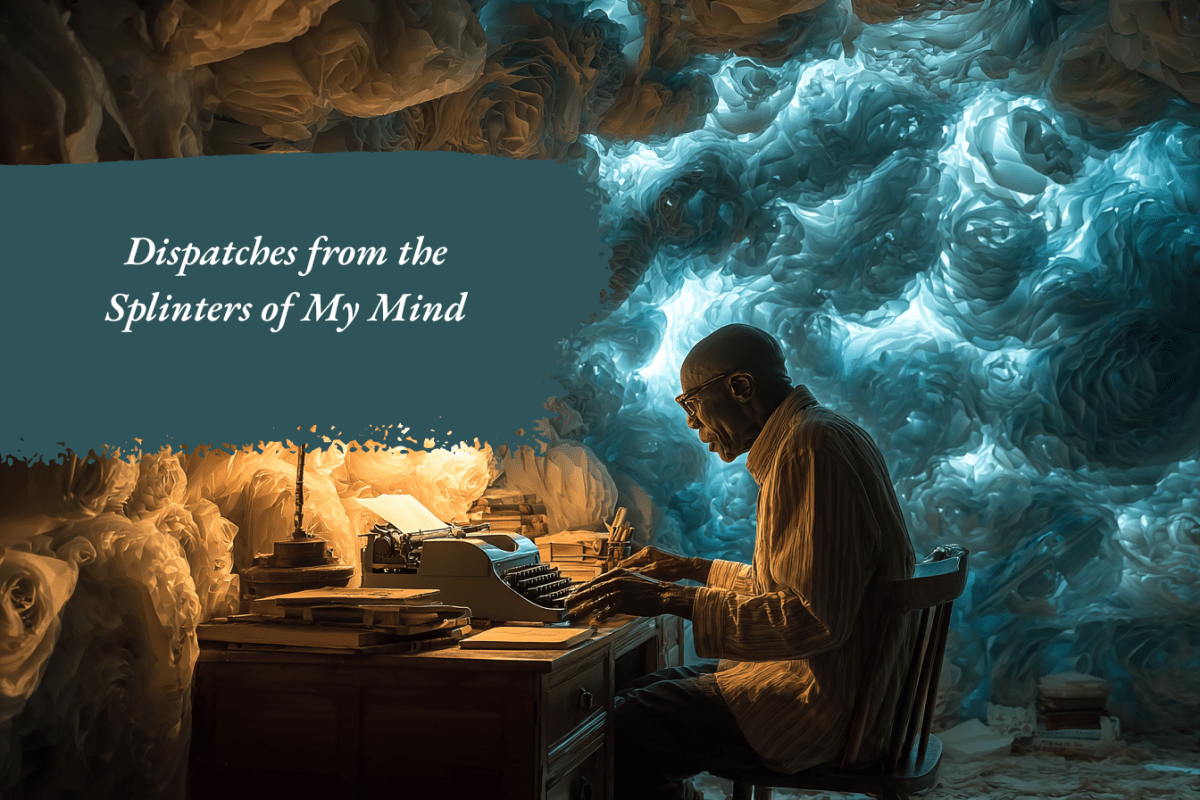
Dispatches from the Splinters of my Mind – Entry 13
I can’t say when the corridor first materialized. There’s no memory of a door ajar, no misstep that explains it. No hinge, no threshold. It simply arrived—complete, unquestioned—as if I had been born inside its walls rather than wandered into them.
That absence troubles me more than the corridor itself. Things are supposed to begin somewhere. Even disasters announce themselves. Here, there was nothing—no sound, no light, no before. Just the corridor, already waiting.
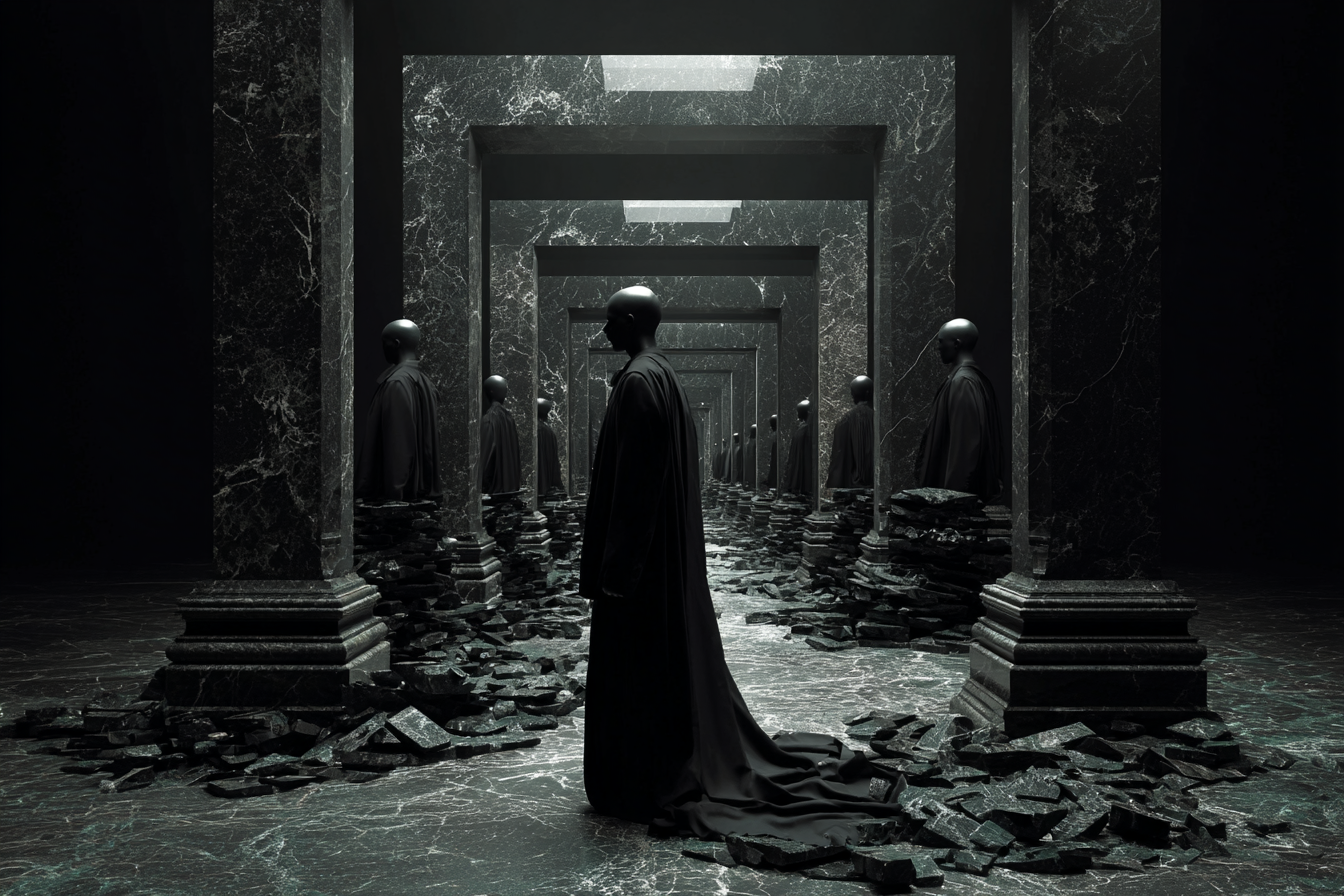
The stone underfoot is smooth in places, chipped in others. Scarred. Once, it might have gleamed. Now it absorbs everything—light, heat, attention. When I stand too long, the cold works its way up through my soles, into my calves, settling deeper than I expect. The air tastes of damp mineral and old stillness. My breath sounds too loud. Like I’ve violated a rule I didn’t know existed.
Columns line the hall, evenly spaced, grey, worn at the edges. Order, at first glance. I try counting them. I always lose track. The numbers slip away before I can hold them. The spacing stays perfect anyway, as if my failure doesn’t matter.
They enclose me like ribs. Protective, maybe. Or something else.
Between the columns stand figures.
Tall. Draped in dark cloth that hangs without argument. No faces turned toward me. No movement. Still, the silence feels occupied. Crowded. I get the sense—not strong enough to prove, not weak enough to ignore—that I am being observed without being acknowledged.
Measured. Not judged. That’s worse.
I tell myself they’re statues. Stone doesn’t remember. Stone doesn’t notice what you’d rather stay buried. I repeat this until it almost settles.
Almost.
Because stone doesn’t breathe. Stone doesn’t shift its weight. And once—just once—I’m sure I see the faintest disturbance near a mouth that isn’t there.
I count again. One. Two. Three. Ten arrives too quickly. The first column feels impossibly far behind me. The corridor refuses to resolve. No vanishing point. No end.
I step forward.
Nothing responds.
No echo. No change in air. Even movement feels unregistered here, like a suggestion the corridor doesn’t bother acknowledging. I take another step, slower. Careful. As if the place might punish urgency.
Still nothing.
It occurs to me—not as panic, not as revelation—but the way one notes an administrative error, that I may have been walking for far longer than I realize.
The figures are closer now. I can see details in the cloth. A frayed hem. A discoloration near the shoulder. Small failures. Human ones.
I stop in front of one.
The head tilts slightly, as if listening for instructions that never arrived. The face is unfinished. Not erased. Abandoned. Close enough.
The posture unsettles me.
Not because I recognize it—but because my body does.
I move on.
The corridor offers no resistance.
Further in, the repetition presses harder. My mind starts supplying differences where none announce themselves. That one looks tired. That one resigned.
That one—
I stop.
The resemblance isn’t in features. It’s in stance. The way the weight settles. The way the shoulders give up without collapsing. Endurance. Learned, not chosen.
I don’t touch it. I don’t need to.
For a moment—longer than I’m comfortable admitting—the idea takes hold that I belong here. There’s space. There’s always space. The corridor doesn’t move people through. It keeps them.
Wrapped in the same dark cloth. Standing. Waiting. Time thinning out until questions lose their edges. It would be quiet. Predictable. Safe in the way anesthesia is safe.
The ease of the thought terrifies me.
I turn and walk on.
The floor changes. Cracks spread across the stone—raised, uneven, pressing up from below. I step around them without thinking. Tripping feels… wrong. Like a violation.
The figures thin. The columns pull back. The silence changes. No longer expectant. Watchful.
Ahead, the corridor narrows.
This should feel like progress. It doesn’t.
I realize I haven’t looked back. The idea of turning around tightens something in my chest. Not because of what I might see—but because of what might not be there. Some confirmations feel irreversible.
The corridor begins repeating itself. The same broken stones. The same chips in the same places. The same figures I’m certain I’ve already passed.
This isn’t familiarity. It’s procedure.
I stop. I listen.
Nothing speaks. Nothing directs. The corridor continues without needing me.
That’s when it becomes clear—not all at once, not cleanly—that this place doesn’t lead anywhere. It keeps records. It preserves versions. It holds what arrives long enough for movement to feel unnecessary.
Time stretches. Thought dulls. The invitation is subtle. Reasonable.
I consider standing still.
The thought lingers longer than it should.
Then I step forward.
Not because I believe there’s an exit.
Not because progress feels real.
But because standing still feels too much like agreement.
 Memoirs of Madness