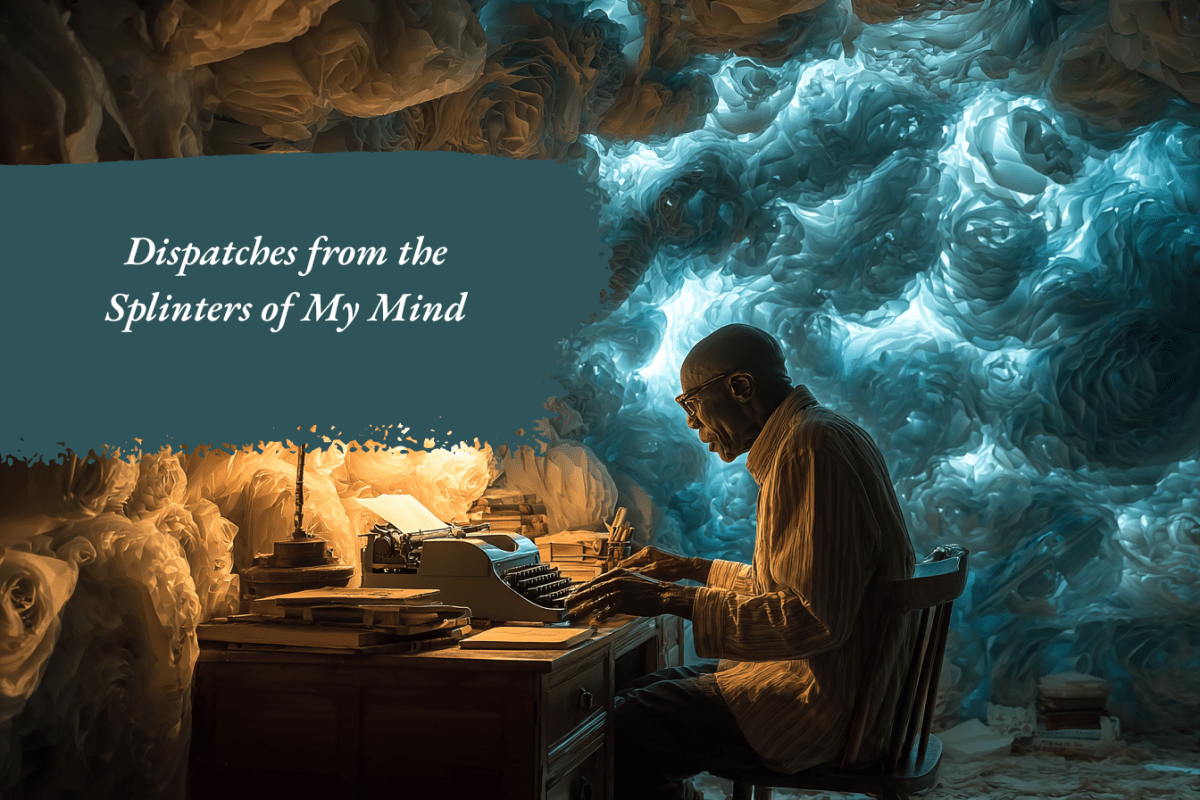
Entry Eleven: Dispatches from the Splinters of My Mind

I found her in the middle of a killing field that should have had no place for beauty.
The moon sat low and full behind her, a pale coin pressed into the sky, casting that cold lacquered light across armor, bodies, and the drifting ash of trampled blossoms. The night smelled of copper and rain. Around us the dead refused to stay still; wind pushed their rags like restless sighs.
I had already decided the day was lost—too many screams, too many men swinging at ghosts. But then I saw her, and the world tilted. She stood where no one should have stood: upright, unhurried, her robe heavy with embroidery, dark as ink, stitched with peonies and waves that shimmered when the moon looked her way.
The first thought that crossed my mind was: Who brings flowers to war?
The second: Maybe the flowers brought her.
They grew around her feet, low white clusters, fragile as breath. Some had taken root in the soft mud, others hovered midair like they hadn’t decided what kind of thing they wanted to be. A faint perfume drifted off them, too clean for this place. And then I realized some of them were growing from her—the side of her face, her shoulder, the line of her arm. A bloom of defiance carved into flesh.
Behind her stood four figures draped in similar black silk, motionless. Their eyes were lowered, hands clasped before them. Attendants, perhaps. Or echoes. Even from where I stood, I knew they weren’t here to fight. They were here to witness.
I tightened my hand on my sword because habit is older than reason.
The ground sucked at my boots as I stepped closer. Somewhere to my left, a man still dying called for his mother. Another, somewhere behind, recited a prayer halfway through his blood. But sound thinned the closer I came to her. Like the air around her absorbed noise and left only pulse.
She looked at me when I was five paces away. Not before. Not after. Like she’d measured the exact distance between recognition and threat.
Her eyes were half-lidded, the color of tarnished brass. Her mouth was calm, as if the ruin surrounding her had been a foregone conclusion. One petal rested just below her cheekbone, pale against the skin. She didn’t brush it away.
“You walk like a man who has forgotten why he still draws breath,” she said.
Her voice was quiet but cut through the air like string through silk.
“I’ve followed death long enough to know his rhythm,” I said. “Some nights he leads. Some nights I do.”
She inclined her head, just enough to show she’d heard. “You are ronin,” she said. “A sword with no oath.”
“Whatever name suits you,” I said. “You stand where no one should stand.”
She looked past me toward the moon. “Where else would I be? When blades sing, flowers bloom. The field requires witness.”
She had no weapon in her hands, yet everything about her said blade. I’ve met killers who strutted under banners, and others who killed softly with no name to anchor their ghosts. She belonged to neither. Her stillness made me feel the way a boy feels before the first snow—expectant, humbled, afraid to speak.
“You should leave,” I said. “When dawn comes, they’ll burn what’s left.”
“You mistake me,” she said. “I came to see who is worthy.”
That word bit. Worthy. I’d watched too many noblemen rot in palanquins to trust it. Worthy is what the dying call themselves before the blade arrives.
“Worthy of what?” I asked.
“Of the sword. Of the bloom. Of carrying death without becoming it.”
The field groaned. A survivor staggered from the smoke—young, wild-eyed, clutching a short spear he didn’t know how to hold. He saw her, and some idiot fire lit behind his teeth. Maybe he thought she was a reward for surviving. Maybe he thought the gods had thrown him one last chance to matter.
He ran at her, screaming.
In battle you have seconds to make a decision. Whether wrong or right, it needs to be made. One of the fastest ways to learn someone is not what they say, but how they fight.
For one breath, I froze. I had seen too much to believe in rescues. The smart thing—the living thing—was to watch it unfold. Yet something in her stillness reached me, a quiet that felt older than every order I’d ever followed.
I moved before thought could argue. Maybe it was reflex. Maybe guilt. Or maybe—and this is the truth I won’t soften—I moved because her movement deserved a blade.
I drew, stepped forward, and cut low. The arc found his thigh. He stumbled, confused, half alive. I turned the motion, cut again—clean, deliberate, final. His blood came hot, red against moonlight. It splashed over the flowers at her feet.
They didn’t stain.
The droplets slid off as if the world itself refused to let his death take root there.
She looked at me, not with gratitude but recognition.
“You took him before he had time to be afraid,” she said. “That was mercy.”
I laughed, short and dry. “That’s a generous name for what I do.”
“There are cruelties worse than steel,” she said. “You gave him a swift exit. That counts.”
Her calm should have offended me, but it didn’t. It steadied something that had been shaking inside for too long.
I studied her again, this time the way I studied opponents before the first strike. Every warrior moves according to what they believe: greed, fear, pride, duty. The body tells the truth the mouth hides. She stood like someone who believed in balance—not victory, not survival, just the quiet between breaths.
“Who are you?” I asked.
“A name is only a sheath,” she said. “Tonight, I am what you see.”
“I see a woman blooming on a battlefield.”
“And I see a man who still listens for music in the clash,” she said. “We are both out of place.”
The four behind her lifted their eyes then—slowly, together. Four sets of dark irises, moonlit, unreadable. The air thickened, like waiting for a storm that didn’t come.
“You could have struck me,” I said.
“I could have,” she replied. “But you already offered your sword.”
“I fought even though it wasn’t my fight,” I said. “Your movements deserved my blade.”
She gave the smallest nod, approval or farewell—I couldn’t tell which. “Then peace, ronin. Not the peace of victory. The peace that lives in the breath between strikes.”
For a long moment, we stood there—two still figures in a world still burning. Around us, the wounded moaned, the fires licked the edges of the field, but none of it entered the space between us. The night had carved a small silence and decided to let us share it.
I let the sword drop, tip resting in mud. Not surrender. A bow to something rarer.
When I looked again, the blossoms at her feet had multiplied. Their pale glow shimmered faintly in the dark, each one perfect, each one refusing the ugliness of what surrounded it.
The moon sank. The smoke grew thicker. I blinked, and she was gone. The four attendants too. Only the flowers remained—untouched, unstained, rooted in earth that should have been ash.
At dawn, when the officers returned with torches and the day’s excuses, they found me sitting beside the blossoms. I told them nothing. Some truths need soil and silence more than words.
I carry her still. Not her image—images fade—but the moment itself, caught behind the ribs like a splinter of light. That memory is my wound and my mercy both.
Because now I know this: even those made for killing can recognize beauty when it stands unafraid.
And once you’ve seen it—truly seen it—you carry it. Always.
Discover more from Memoirs of Madness
Subscribe to get the latest posts sent to your email.
 Memoirs of Madness