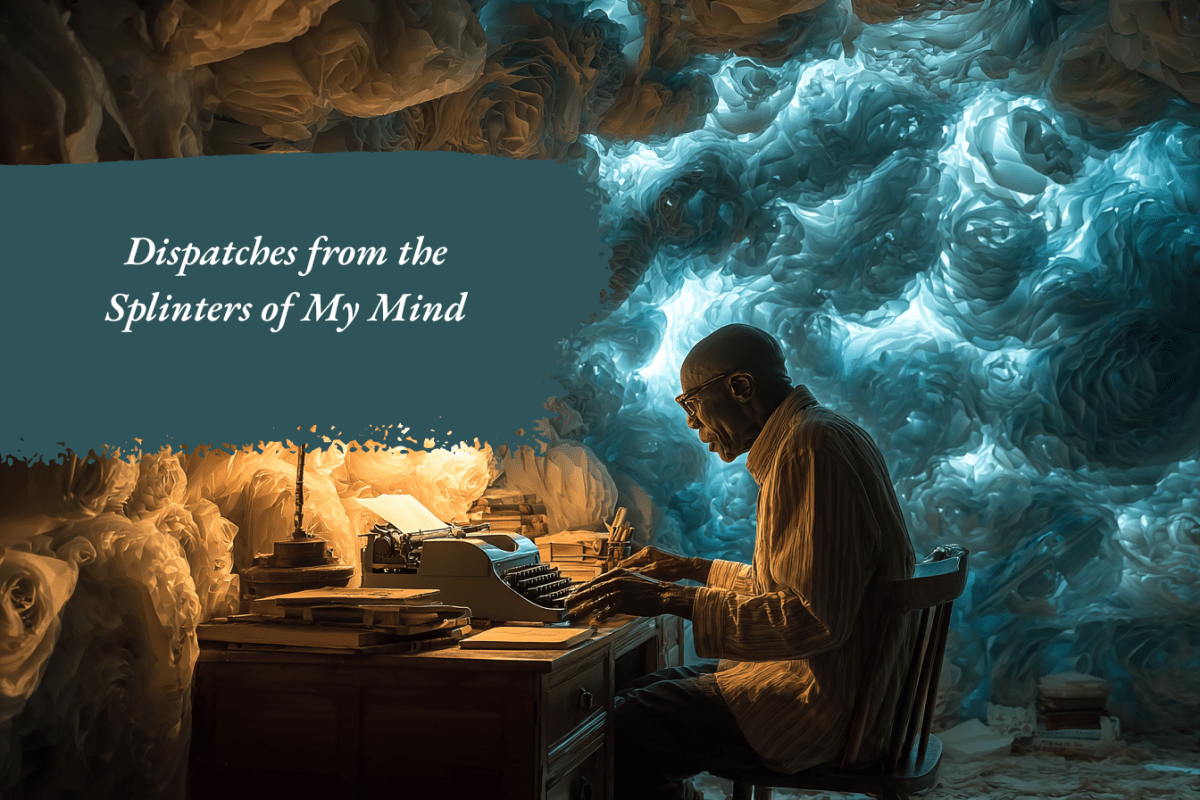
Entry Nine: Dispatches from the Splinters of My Mind
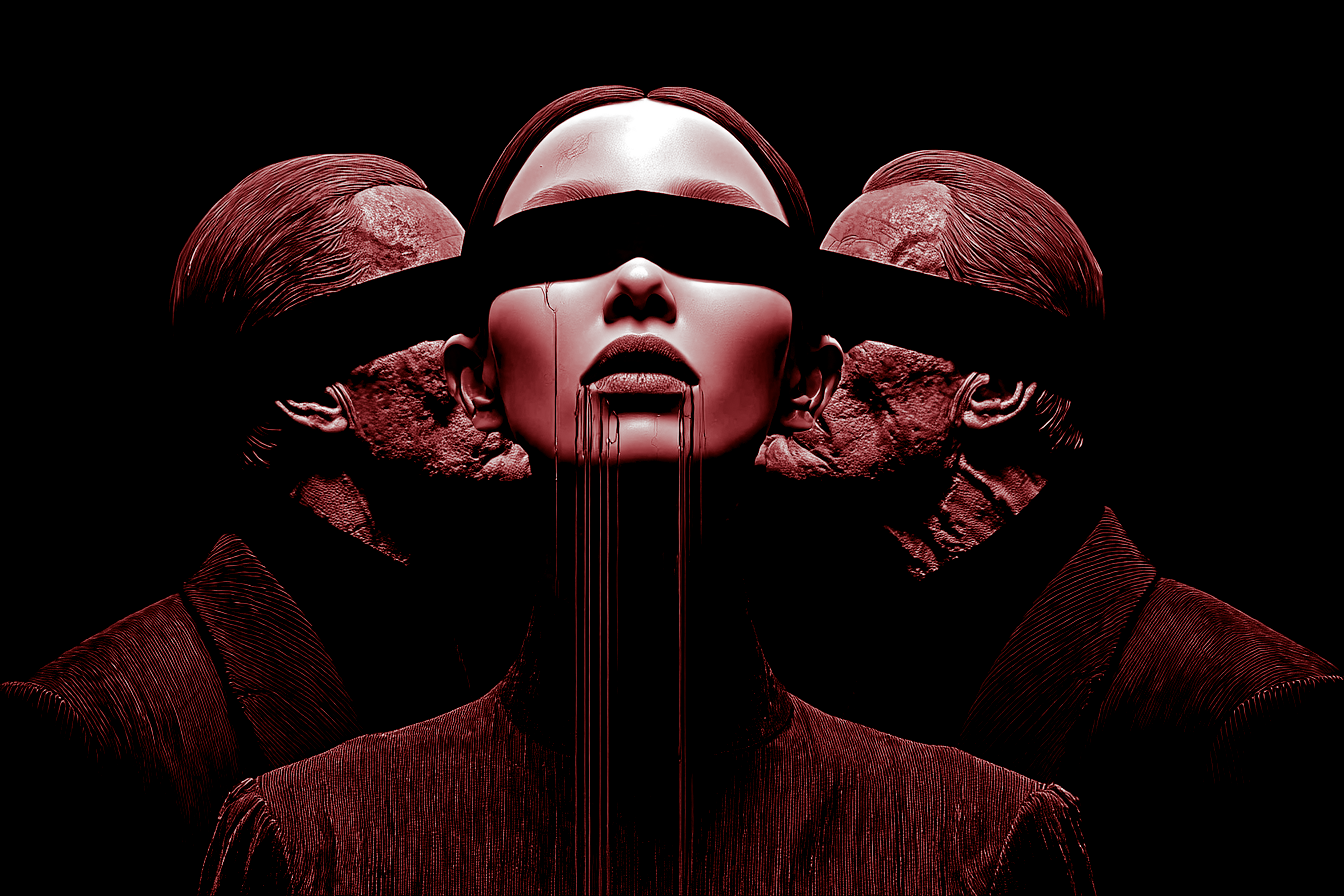
I wake upright, as though sleep forgot to fold me into its arms. The darkness presses in all around—soft, velvety, bruised at the edges, like some colossal bruise pulsing with the low red hum of my own blood. A cloth lies warm against my eyelids, its fibers slick where they touch my skin, chillier at the edges where the air’s breath finds purchase. I don’t brush it away. I’ve learned that on certain nights the world is safer unseen.
They breathe at my sides—two hulking presences, rigid as ancient statues steeped in the sick-sweet perfume of formaldehyde. One on my left, one on my right, like bookends clamped around a story that refuses to end. Their feet remain statuesque; instead their bodies rock ever so slightly, tilting inward, receding, then returning in a silent metronome of doubt. Sometimes they feel like mirrors, their gazes jokers with opinions. Sometimes they feel like promises, the future I was sold if I kept doing what I was doing. Most nights I know the truth: they are mine—either I forged them, or they forged me. Asking which first feels as impolite as inquiring whether the flame or the candle existed before the other.
“Don’t speak,” says one voice—dry, brittle, like my father after my brother’s funeral. “Don’t confess,” says the other, rasping through a cough that smells faintly of candle wax and stale hymns. Their words scratch the hollow behind my left ear, the birthplace of my worst headaches. These aren’t commands so much as rituals—family heirlooms too awkward to discard, for to do so one must acknowledge their worth.
But my mouth conducts its own liturgies. It leaks in secrets. A weight gathers on my tongue: metal and warmth, the taste of regrets I should have voiced long ago. The first word is always the hardest to birth. When it finally breaks free, every syllable remembers gravity and falls like ink that missed its page, staining my chin.
It’s all right, I tell myself, between ragged breaths. Blood is just memory liquefied. Let it run. Let it tally the score.
“How did we get here?” I whisper, voice ragged against the blindfold. The dark tilts its head and pretends not to hear.
Left says, “By keeping your eyes closed.”
Right hisses, “By learning to love the closing.”
They speak in turns, careful not to overlap, for if they did the shape of this place would shift and I’d forget what it means to stand.
I was taught early that silence is a language with two alphabets—safety and surrender—both scrawled from the same letters. When the cops came to our flat for the second time, my mother pressed a thumb to my lips. It felt like blessing and gag in equal measure. Years later, the first woman who claimed she understood me asked if I had anything to confess. I answered “No” because survival had already flipped the coin. I’ve whispered apologies to her in colder seasons, at bus stops I never ride, through prayers I don’t believe in. None ever breached the blindfold—they slid back down, patient as ghosts.
I know what lurks beneath this cloth. I’ve seen it—how daylight has kissed it, streetlight has tasted it, how a match’s flame stared too long and flinched. Eyes that catalogue, that inventory every fracture, then try to alphabetize the fragments. If I unveil them tonight, I’ll stare out into a flock of unfinished things circling my bed—wounds and half-formed promises. One can drown in the study of omissions. Ask me how I know.
Left leans forward, winter on his breath: the damp, hollow kind that drifts through stairwells, eavesdropping on arguments. “We kept you alive,” he says, a tenderness reserved for things long dead. “We wrapped your seeing until your seeing couldn’t hurt you.” The years have built a fortress in his jaw, doors forgotten.
Right lifts a hand to graze my ear—his touch colder than patience. “We taught you an economy of withholding. What you don’t utter can’t be used against you. What you don’t name can’t die.” He pauses, fingers poised like a man waiting for payment. “We saved you from the truths that detonate families into committees.”
Between them lies a rasp—a rasp that, I realize, is my own.
I drift back to the riverbank, red water flowing like a personal insult to the city. I recall the neon sign in that solitary room—its sick throb of light like a wound bargaining for closure. I hear the voice that begged me to “keep the light on,” and how I switched it off, hoping the corridor would keep a secret of its own.
Silence exacts its own fee. It demands tiny coins—words unsaid, memories locked away—until one day you want to catch a bus out of town and all you possess is the jingle of borrowed time.
“Say it,” Left murmurs, not unkindly.
“Say nothing,” Right counters, like a physician prescribing illness.
My lips part. Perhaps it is prayer, perhaps confession—perhaps the last valve cracking open in a machinery someone else designed. What I long to say is simple: I remember the first lie—it tasted like rescue. The second lied felt like rehearsal. The third taught me grammar, and the rest built a house around me: no windows, just a door opening onto a closet. I want to say that blindness, if chosen wisely, lets you aim without seeing your target. That I learned to navigate by the shadows where stars should be. And I want to speak her name, the one I’ve carved into the walls of my heart, the one whose echo never returned but whom I have nurtured in silence for years.
Yet the mouth refuses dictation. When words drop onto my collar, I taste ash on my tongue. If I linger here, the floor will absorb me letter by letter. Maybe that’s the plan: let the body become a document, the words falling where they will.
“Open,” Left instructs—not my eyes, but the wound beneath this cloth.
“Close,” Right insists—not my lips, but the subject itself.
They kneel, each in reverent posture, calling it unity.
I am not devout. Faith in myself is a belated apology—a jacket thrown over my shoulders after winter has already laid bare my bones. Still, I believe in small truths: every silence is a room with a window you can paint shut; blood remembers what you refuse to; when the past leans in to kiss you, check its hands.
“Why do you resent our aid?” Right asks, almost plaintive.
“I don’t,” I rasp, the cloth muffling my words. “I’m just weary of living the shape of your absence.”
Left’s fingers find the knot in the blindfold with a lover’s care. He doesn’t tighten, only taps it, as though weighing a wish. “You won’t like what you see.”
“I rarely do,” I reply, a dry laugh clawing free.
“Then keep the cloth,” he says. “And we’ll keep you. We’re the railings in your dark.”
I envision rusted metal, cold to the touch, a splinter waiting for skin. I recall the staircase winding down to a door I never open—the handle of which somehow knows my name. Once I thought that room housed my monsters. Now I see the real monsters are proper: they safeguard my unspent courage and the coats of selves I never became.
“I have questions,” I say, voice gentle as rain. “Whose mouths whispered before mine? Where did the very first hush come from? How many women stifled their fire because the men who taught them already drowned in smoke? How many fathers measured love by volume, awarding themselves with silence?”
Left inhales, a slow vacuum. Right clears his throat like a clerk shelving confessions.
“You think your blood makes you singular,” Left says. “It only makes you consistent.”
“You think speech is salvation,” Right counters. “Speech is a tool—tuned for mercy or murder.”
Both statements are true. Both can kill.
The cloth grows heavy, soaked where its letters dissolved in transit. I recall the story of a saint who plucked out his eyes to end desire, of a soldier who bit off his tongue so no one could barter his secrets. Every tale shares the same architect: Sanctity. Security. Surrender. The walls remain flawless. The rooms numbered. No one explains the numbers until rent’s due.
“Remove it,” someone says, and I can’t discern whose voice borrowed mine this time.
My hands lift, obedient as shadows at dusk. The knot is simple—always was. The hardest part of a blindfold is the narrative that says you deserve it. I tug once. The cloth exhales. Light rushes at me with the relief of a crowd that finally chose a side.
The room reveals itself—smaller than I’d feared, grander than I’d earned. The two men are exactly as the voice in me conjured: tattered elegance, wreckage with meticulously combed hair. Their faces are maps whose borders have vanished. Their suits hang as carefully as funeral garb. Their hands hover, almost kind.
I look at Left. He looks at my past. I look at Right. He looks at my future. Neither steps forward. I remain the hinge.
Blood trickles from my chin, a rudimentary signature poised for the name that owns it. I want to wipe it away. I want to revel in it. I want to stand still and hear what stillness says.
“Are you ready to speak?” Right asks, tone hopeful.
“I have been speaking the whole time,” I say, and for the first time the room curves into something like a smile.
Left shakes his head. “If you go on, you’ll lose us.”
I meet his eyes—meet my inheritance. “Maybe you’re meant to be lost.”
Pride and regret war in his gaze, as if he’s a father examining the bruise he taught me to take. There’s curriculum here no syllabus could contain.
“You can’t survive the noise,” he warns.
“Then let the noise survive me,” I tell him. “Carry the parts I cannot.”
When I finally move, it is unceremonious. I am neither saint nor soldier tonight, only someone who learned to count by the drip of blood in the dark. I am someone who believed in railings and now tries to believe in stairs. I am someone who has loved poorly, remembered perfectly. My fingertips trace the cooling red at my jaw, smearing it as though to bless myself—two fingers pressed to skin, raising a silent benediction. I draw a thin line across my throat—not threat, but witness. Then I touch each eyelid, first right, then left. Their warmth whispers secrets textbooks never taught.
The two men release simultaneous sighs of opposing relief. They are both disappointed. They are both relieved. It is possible to be two sermons at once.
A neon sign shivers somewhere beyond these walls. A painted-shut window in another life wonders if tonight the paint might crack. The floor holds my secret. The air remembers it was once a river and yearns to practice.
“I won’t speak her name,” I murmur, voice low but unwavering, “but I will stop pretending I never learned it.”
Right bows. Left closes his eyes. The room narrows to a path that was always here.
I take a step. Then another. My mouth finally ceases bleeding—it has, at last, done its duty. The cloth in my hand is merely cloth. I let it fall. Its descent makes no sound anyone else would hear.
If I keep walking, perhaps the past won’t follow. If it does, we can negotiate. I’ve learned there are nights it’s safer to close your eyes—and nights when you must open them, so when the world returns wearing your own voice, you can tell prayer from muzzle.
Tonight, I listen for that difference. And if the voices demand a choice, they can wait—like the weather.
 Memoirs of Madness