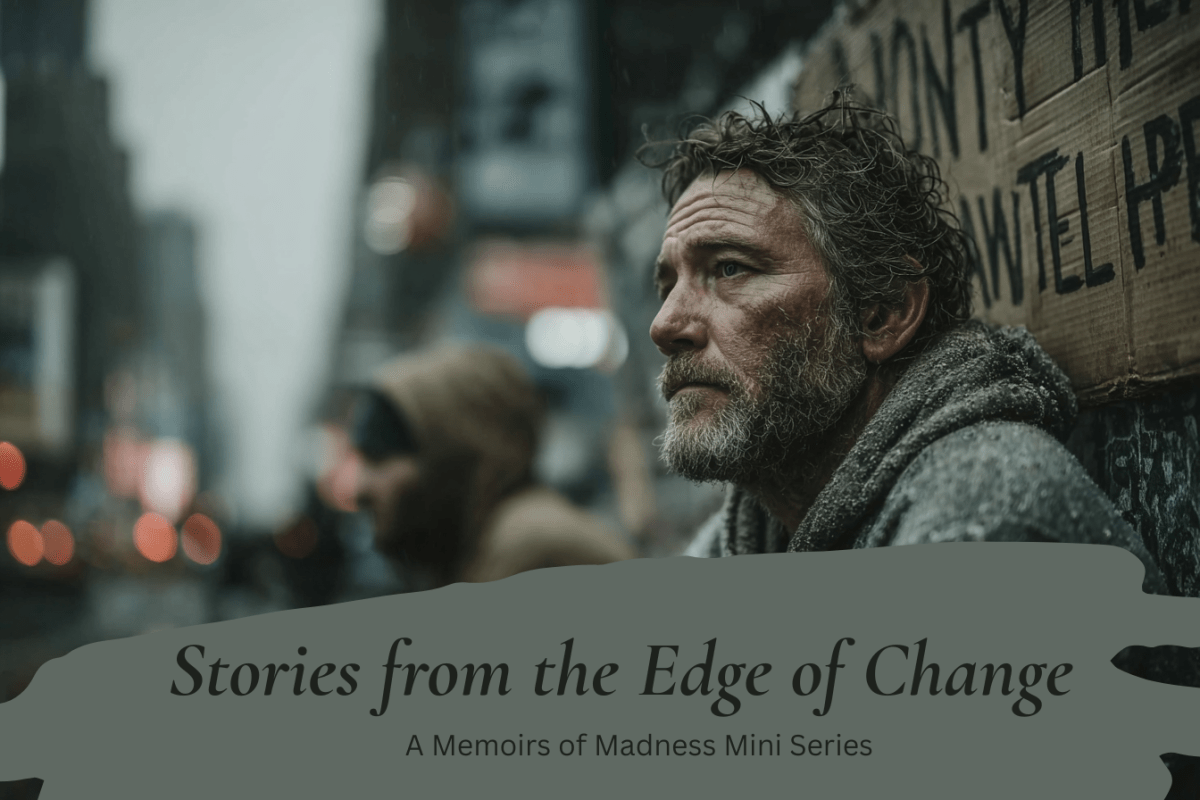
MoM Series: Stories from the Edge of Change – Part 5
Jake slipped back to Maple and 9th, just before the day’s first sirens.
The sky was a cold bruise overhead—indigo leaking toward gray, the city below still sullen and half-swallowed by fog. Jake’s route here was always the same: the recycled bus air, the smell of new concrete and old bleach at the transfer station, the long walk down streets that still remembered him in all the wrong ways.
He’d liked it better in the days when a hangover let you lie to yourself.
Being sober meant memory was out to get you, every hour of the day.
He hadn’t told anyone he was coming, and wasn’t sure anyone would care. Maple/9th wasn’t home, not really, but the corner had a way of calling him back when the rest of the world got too bright and too loud. Where everything had fractured. Where, by some backwards logic, something like a beginning had managed to dig in and take root, though even now Jake couldn’t explain why.
He stepped off the curb, the city unspooling around him in the blue-tinted hush of pre-dawn. Chains of streetlights blinked uncertainly overhead, fighting the thick mist that made them look like distant, drowned stars. Gutter water gurgled past slumped trash bags, and a wind—sharp and chemical, the kind you only got east of the river—whipped Jake’s soaked collar tight against his throat.
It had rained all night, the kind of slow, pounding storm that got past old window seals and filled alleys with shallow, fast-moving currents.
His boots were soggy from the first block, each step a cold squelch that made him feel both present and exposed.
He carried a dented thermos of black coffee in one fist, and two foil-wrapped breakfast sandwiches in the other. Not an offering; nothing so grand. More like insurance, or ballast, a way to keep his hands busy while waiting for the morning to decide what kind of day it wanted to be.
Jake found his bench across from the bus stop, same warped planks as always, streaked deep with mildew and the ink of other people’s initials. He sat with a practiced slouch, elbows braced on thighs, letting the bench’s damp give him a chill. The wood was beaten soft by years of sun and rain and the pressure of bodies like his—bent, but holding.
The crust of the world here was thin. Every sound cut through.
The city at this hour was a hungover beast, makeshift and miraculous: somewhere a dog barked in warning, a power transformer hummed in gradual crescendo, and a garbage truck, like the planet’s own heartbeat, thudded trash cans up and down the block.
Jake finished his first sandwich in three bites, washing it down with coffee so bitter it felt like punishment. He watched steam coil off the thermos and disappear.
He’d been clean for 343 days—he counted, because not counting was the first step to failure in his book—but the mornings punched hardest. Not cravings, exactly, but the thin, raw quiet where the old engine used to run. The ache was in the absence now, the stretches of time where nothing screamed at you from the inside.
He wondered if he was the only one who found the lack scarier than the compulsion.
People talk about recovery like it’s a sunrise, he’d heard at every group and meeting and shelter table in the city, but that was a lie.
Recovery was more like hitting bottom, and instead of dying, realizing you were still clutching the shovel.
The old-timers called it “the work.” Jake wasn’t sure he believed in the work, but he did believe in gravity, and he knew how easy it was to fall back down the hole.
He wiped rain off his forehead and stared at the bus stop across the street.
The city here was built in layers, old and new pressed together without much logic: a granite Gothic church wedged between a vape shop and an all-night copy center, tenements with windows starting to glow against the gray, stairwells already moving with the first shift crowds.
The light grew by inches. Jake’s eyes stung; he blinked, forcing himself to watch the street, not the rearview movie in his head.
A figure emerged from the alley behind the liquor store, hood low, gait ragged.
Jake tensed—still, after all this time, the old alarms worked.
Then he recognized the walk. Shoes caked in mud, chin up, hands buried deep in a jacket two sizes too big: Angel.
Angel had been a regular at the shelter through four of Jake’s own city-sponsored relapses, which made him family, or as close as anyone got these days. Compared to the Angel of last summer, this version moved with more purpose—less side-to-side drift, no fresh scabs or glassy stare. Angel’s jaw was bruised, but healing. The eyes were alert, focused, like he’d learned to see himself again.
They shared a nod—the kind that says, I see you and I know what you’ve been through, and also, let’s not make this a big deal.
Angel slid onto the bench beside him, landed hard, and let his backpack fall at his feet. Water pooled around their boots, the surface speckled with cigarette ends, leaves, and plastic fork tines.
Neither of them spoke for a stretch.
Jake thought about the time, months ago, when a rehab flyer had drifted down onto his lap from a passing outreach worker. He’d already been clean then—technically, anyway.
Time had a way of flattening out, making you forget how long you’d actually been at it. The city kept its own clock, indifferent to anniversaries.
Some mornings, like this one, Jake felt it pressing in, the weight of nothing left to want except to stay above water.
Angel broke the silence first. “You been coming here a lot?” His voice was hoarse, wary, but there was something sturdy in it, too.
Jake shrugged, tracing a finger along the bench’s warped grain. “Now and then. Corner doesn’t judge.”
Angel pulled a sandwich from the foil and bit in, chewing slowly. “Doesn’t judge—but it remembers,” he said, mouth half-full.
The words hung in the fog, true in a way that made Jake’s teeth ache.
They watched the city wake up.
A woman jogged by—neon sneakers, rain-spattered leggings, earbuds locked into some other world. Down the block, a man in grimy overalls hosed vomit from the stoop of a shuttered bar, his movements quick and practiced.
A bus hissed to a stop, doors gasping open. Nobody got on or off.
Jake passed the thermos to Angel, who sipped and grimaced.
“You still at the center?” Angel asked.
Jake nodded toward the east, where the sunrise was starting to show. “Nights only. Fewer ghosts after midnight.”
Angel wiped his mouth with the back of a sleeve. “Heard you made it eleven months,” he said.
Jake didn’t correct him; time was a rumor on the street.
“I’m two months today,” Angel added, voice almost too soft to carry.
Jake tipped the thermos, spilling out a little coffee to mark the moment.
“That’s something,” he said.
Angel stared out at the rising light, sandwich forgotten in his hand.
“It feels like it could vanish any second,” he said. “Like, if I turn around too fast, it’ll all come back.”
Jake leaned back, the bench groaning under his weight.
He studied the old traffic light—still stuck on red, despite the empty streets.
“Sometimes it does,” he said, “but you don’t.”
The words were barely a whisper, but Angel nodded.
They both knew the math: most of the people who made it this far didn’t stay far for long.
The city was littered with their ghosts—names Jake remembered from the group, faces half-blurred by time and by the drugs that used to be his only way to see clearly.
Angel finished the sandwich and wiped his hands on his jeans. “Ever think about running?” he asked, eyes fixed on the pale clouds.
Jake didn’t have to ask where. “All the time.” He closed his eyes, felt the rain seep through his sleeves, and pictured a map with every city crossed out except this one.
Angel laughed, short and sharp—almost a bark. “I dream of a boat, man. Offshore. No laws, no meetings, nobody waiting to see if you fuck it up again.”
There was a wildness in his voice, but also a kind of longing.
Jake recognized it: the fantasy of disappearance, of finally outpacing your own story.
“You take yourself with you,” Jake said.
Angel let out a breath, not quite a sigh. “Yeah. That’s the problem.”
Across the street, a man in a threadbare hoodie sorted through a heap of cardboard, folding it into a sign.
His hands shook just enough to notice. The buses kept rolling by, ignoring him.
Jake watched as the man scrawled something—maybe a prayer, maybe a joke—across the cardboard and propped it up for the world to see.
Angel noticed, too. “You going to say something?” he asked.
Jake shook his head. “Not yet.”
“Why not?”
He thought about it. “First time, nobody listens. You wait until they look up without asking. That’s when they’re ready.”
Angel stared at the man for a long time. “And if he never looks up?”
Jake pressed his boots flat against the concrete, feeling the water squish beneath the sole.
“Then we stay,” he said. “Until he does. Or until someone else comes along who knows how to wait.”
Angel didn’t answer. But he didn’t move either. That was enough.
There were mornings when Jake imagined leaving—not running, just… slipping away. Boarding a train headed somewhere nameless, getting on a boat, disappearing into the haze like an offshore storm no one tracks.
But he never moved. Never packed. The fantasy was like a scar: it only hurt when you pressed.
He stayed because someone had once stayed for him.
That’s all it had ever taken.
The bench creaked beneath his shifting weight.
The corner, as always, said nothing.
But it remembered.
And Jake—sober, scarred, still learning—remembered too.
🖋️ Final Author’s Note:
Today’s story incorporates the prompt words offshore, downpour, and creed from FOWC, RDP, and Word of the Day.
This marks the final chapter in the first arc of Stories from the Edge of Change, a MoM original series about survival without spectacle.
Jake didn’t get a miracle. He didn’t get closure. He got a bench, a corner, and a reason to stay long enough to matter.
Sometimes, that’s all we get.
And sometimes, it’s enough.
Discover more from Memoirs of Madness
Subscribe to get the latest posts sent to your email.


The bench is his anchor.
LikeLiked by 1 person
Thanks, Alice
LikeLiked by 1 person
Good finale Mangus.
LikeLiked by 1 person
Thanks, Di
LikeLiked by 1 person