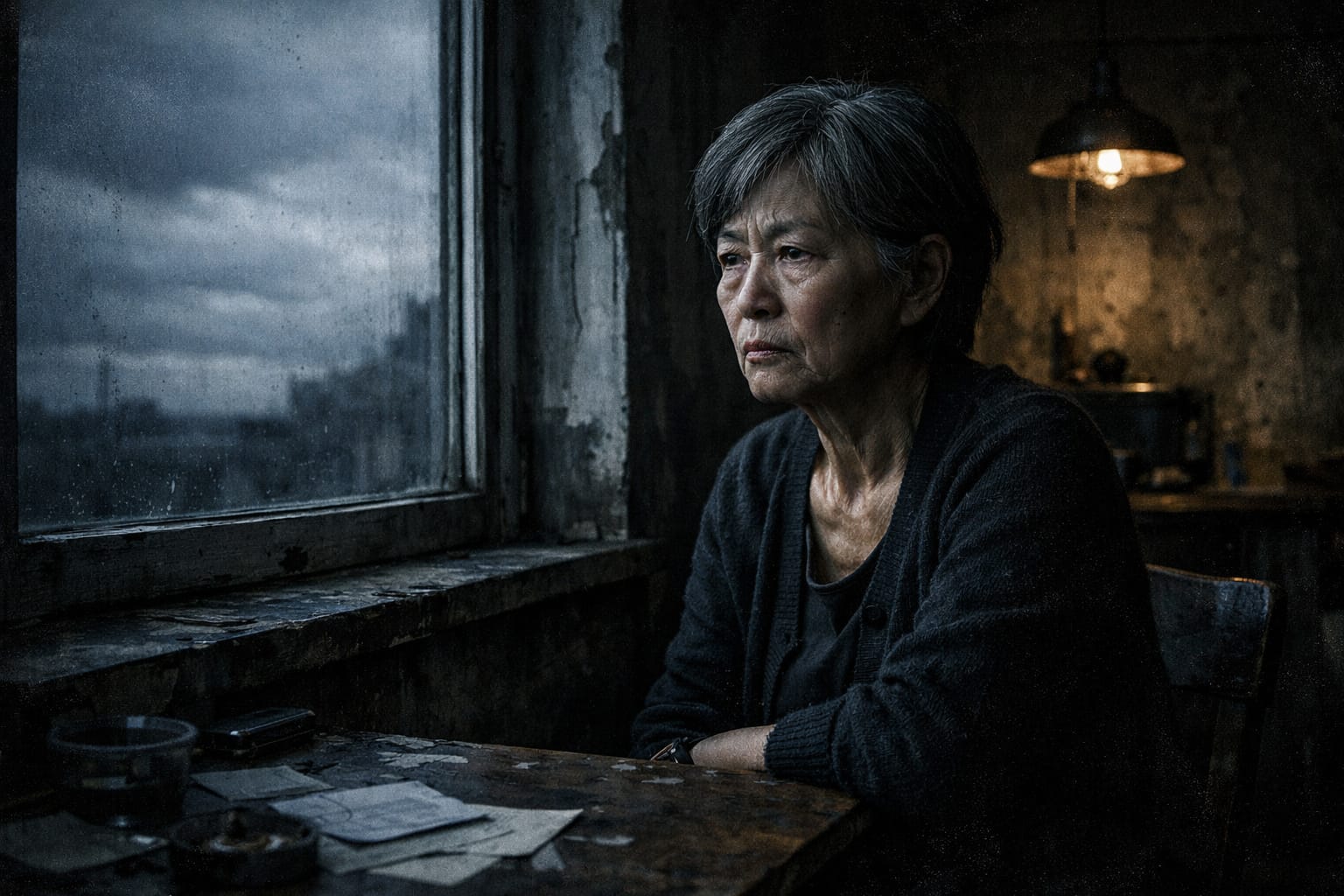
The rain started before dawn and never bothered to stop. It just hangs there on the window like the sky forgot what it was supposed to do next. I sit at the table with my coffee going cold, watching the drops slide down the glass, each one taking its own crooked path. Funny how water never falls straight, no matter how much gravity insists.
Most mornings begin like this now. Quiet. Heavy. Waiting.
Waiting for her to wake up.
Waiting to see which day it will be.
I never thought this would be my life. Not like this.
Not at my age, when the body already starts making its own complaints.
Not when the hands ache before the work even begins.
My aunt sleeps in the next room. Eighty-seven years old, bones like dry sticks, mind like a house with the lights left on in only one room. The doctor called it dementia, like the word itself could explain what it feels like to watch someone disappear a little more every week.
I am her sole caregiver now.
Not because I wanted to be.
Because there wasn’t anyone else left who would.
People say things like,
“You’re a good person for doing this.”
They don’t see the kitchen at midnight.
They don’t see the laundry piled higher than the sink.
They don’t see the way your back locks up after lifting a grown woman who can’t remember how to stand.
They don’t see the days you forget to eat because you’re too busy making sure someone else does.
This morning she wakes up calling for her sister.
My mother.
Dead ten years now.
“Alice?” she says from the bedroom.
Her voice small, frightened, like a child lost in a grocery store.
I close my eyes before I answer.
Just one second.
Just enough to get my face right.
“I’m here,” I tell her.
When I walk in, she looks at me like she’s trying to place a stranger she met once a long time ago.
Sometimes she knows me.
Sometimes she doesn’t.
Today she studies my face like she’s searching through old photographs in her head.
“You look tired, Alice,” she says.
For a moment, I almost correct her.
Almost tell her who I am.
But I don’t.
Because on the days she thinks I’m her sister, she feels safe.
And lately, safe is the only thing I can give her.
Caregiving sounds like a soft word.
Like something warm.
Like soup and blankets and patience.
Nobody tells you about the lifting.
The way her weight goes dead in your arms when she forgets how to move her legs.
Nobody tells you about cleaning things you never imagined you’d have to clean.
Nobody tells you how cooking becomes less about food and more about survival.
Eggs.
Toast.
Soup again because it’s easy to swallow.
You start measuring time in meals and pills and naps.
And somewhere in the middle of all that, your own body starts to give up ground.
My knees hurt when I stand.
My hands shake when I hold the kettle too long.
Some nights I lie down and my heart beats so hard I wonder if it’s trying to get out.
I went to the doctor once.
He said stress.
Said I needed rest.
I laughed at him.
Rest from what?
From being the only one left?
The hardest days aren’t the ones where she forgets everything.
It’s the days she remembers just enough to know something is wrong.
She looks at me with those cloudy eyes and says,
“I’m not right, am I?”
And I tell her no.
I tell her she’s fine.
I lie because the truth would break her.
Other days she calls me Mother.
“Don’t leave me,” she says, holding my sleeve like I’m the last thing in the world that makes sense.
And I sit there beside her bed, rubbing her hand, feeling the bones under the skin, thinking about how this is all first-hand, no stories, no training, no book that tells you how to do this without losing pieces of yourself.
You learn as you go.
You break as you go.
You keep going anyway.
Sometimes I sit by the window after she falls asleep, like I am now, watching the rain crawl down the glass.
I try to remember what my life felt like before this.
Before the pills.
Before the lifting.
Before the nights she wakes up screaming because she thinks the house belongs to someone else.
I try to remember who I was when my only responsibility was my own breathing.
It feels like a different person lived that life.
A stranger.
Funny thing about aging.
You don’t notice it all at once.
It happens in pieces.
In small trades.
You trade your time.
Then your strength.
Then your sleep.
Then your health.
And one day you look in the mirror and realize you’re not just taking care of someone who’s disappearing.
You’re disappearing too.
She calls from the bedroom again.
“Mother?”
My hands hurt when I push myself up from the table.
“I’m coming,” I say.
And I go.
Because that’s what you do when you’re the only one left.
 Memoirs of Madness