
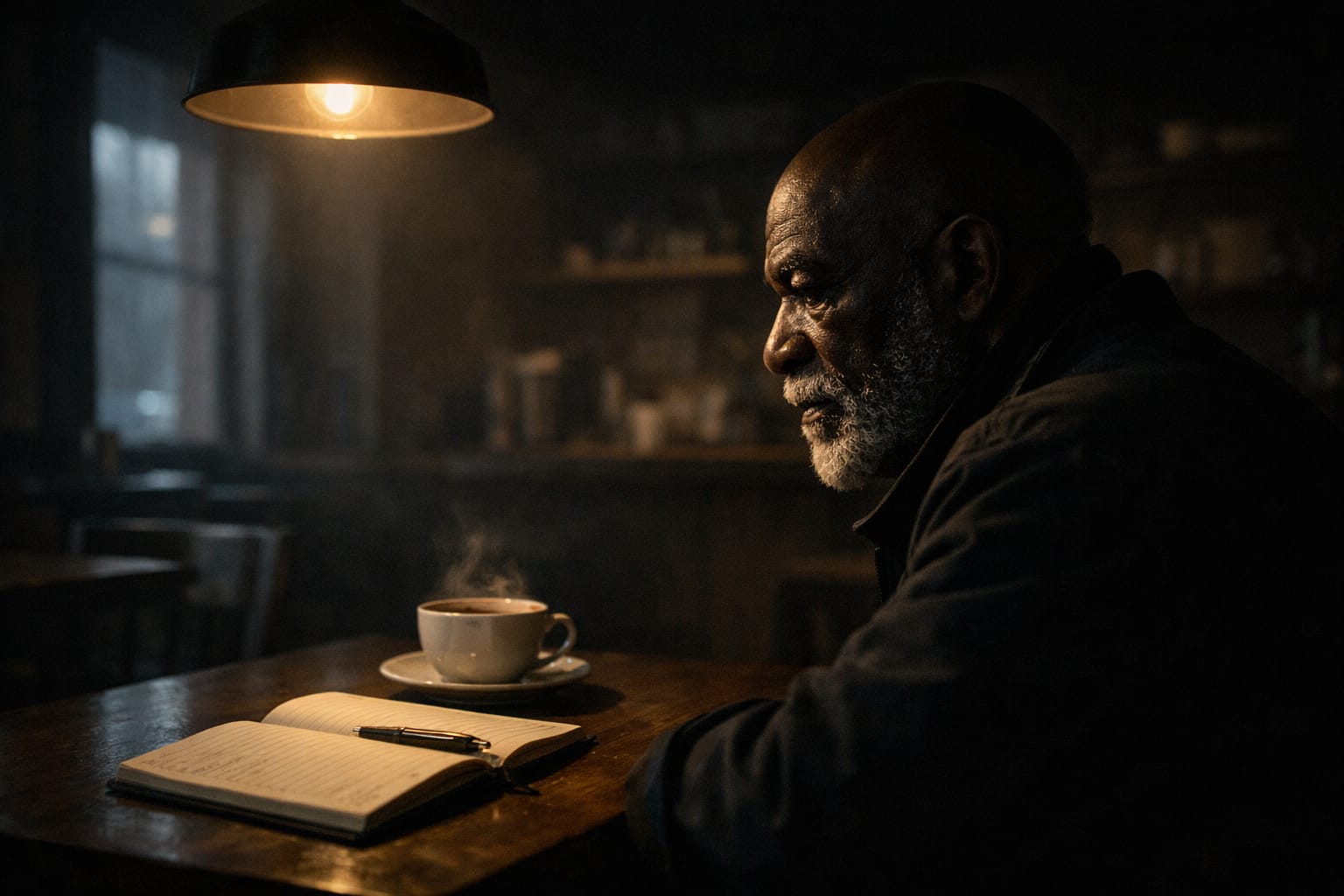
The café was nearly empty, the way it always was at that hour, when the city seemed to hold its breath between one intention and the next. A single bulb hung low over the table, casting a tired halo that didn’t quite reach the corners of the room. He sat beneath it with his shoulders rounded, as if the light itself carried weight, the familiar ache between his shoulder blades reminding him how many mornings had begun this way.
Steam lifted from the cup in front of him, thin and persistent, carrying the faint scent of something burnt at the edges. He didn’t drink it right away. He rarely did. Coffee, like memory, was better approached slowly. The notebook lay open, its spine softened by decades of use, pages crowded with a handwriting that had grown tighter over the years—as though space itself had become something to ration.
He had started the book long before he understood why. Since his father’s death, maybe longer. Names filled the early pages. Dates. Places half-remembered, half-invented. A census line here. A marriage record there. Ordinary things, assembled carefully, as if order alone might explain what had always felt misaligned. The ink had faded in places, smudged where a younger hand had dragged across still-wet letters. He traced a finger over his father’s birth date and wondered, not for the first time, if he had ever truly known his family at all.
Outside, a bus hissed to a stop. Inside, the café remained still.
He paused, pen hovering above the page. A name appeared twice in the records—his grandfather’s—attached to two different women in two towns separated by less than thirty miles. The dates overlapped by three years. He ran his thumb across the indentation in the paper, feeling something settle behind his ribs. It wasn’t proof. It was something worse—suggestion.
They say everyone who looks into their family history will find a secret sooner or later.
The thought didn’t arrive like revelation. It settled. Heavy. Familiar. He lifted the cup and drank, the bitterness grounding him. The past, he had learned, rarely announced itself. It preferred patience.
He turned the page.
What followed wasn’t violent or scandalous. It was quieter. A pattern of omissions. A child listed as “lodger.” A death without cause. A man who moved on easily while others slipped out of the record altogether. There was something almost methodical about it, something faintly sinister in its restraint, like footprints carefully wiped away, leaving only the suggestion of passage.
He closed the notebook and wrapped both hands around the cup. The warmth spread into his fingers, steady and real. Whatever he had uncovered didn’t change who he was—but it explained the silence he’d grown up inside, the way truth had always been treated like something fragile, dangerous, best kept out of reach.
Outside, the bus pulled away. The café’s clock ticked on.
He paid, nodded to no one, and slipped the notebook into his coat, feeling its weight settle against his side. Some secrets didn’t ask to be exposed. They only asked to be acknowledged, carried forward with care.
He stepped back into the cold, the door closing softly behind him. The notebook pressed against him with each step, a quiet reminder that he was just another link in a long chain of silences—and that the light and steam and unanswered questions would follow him home, patient as family ghosts.
Author’s Note
This piece was written in response to the quiet pull of two prompts that lingered longer than expected. My thanks to Fandango for hosting FSS#229, and to Di for MM309. Both offered just enough space to let the story find its own footing. Sometimes the right prompt doesn’t demand an answer—it waits, patient, until the words are ready to catch up.
 Memoirs of Madness