Personal Reflection
People love to dismiss imagination as escape.
As if leaving the visible world for a while means abandoning truth. As if dragons, ghosts, invented cities, haunted futures, and impossible kingdoms are somehow less serious than office lights, overdue bills, and the daily machinery of survival.
But fantasy has always known how to smuggle reality past the guards.
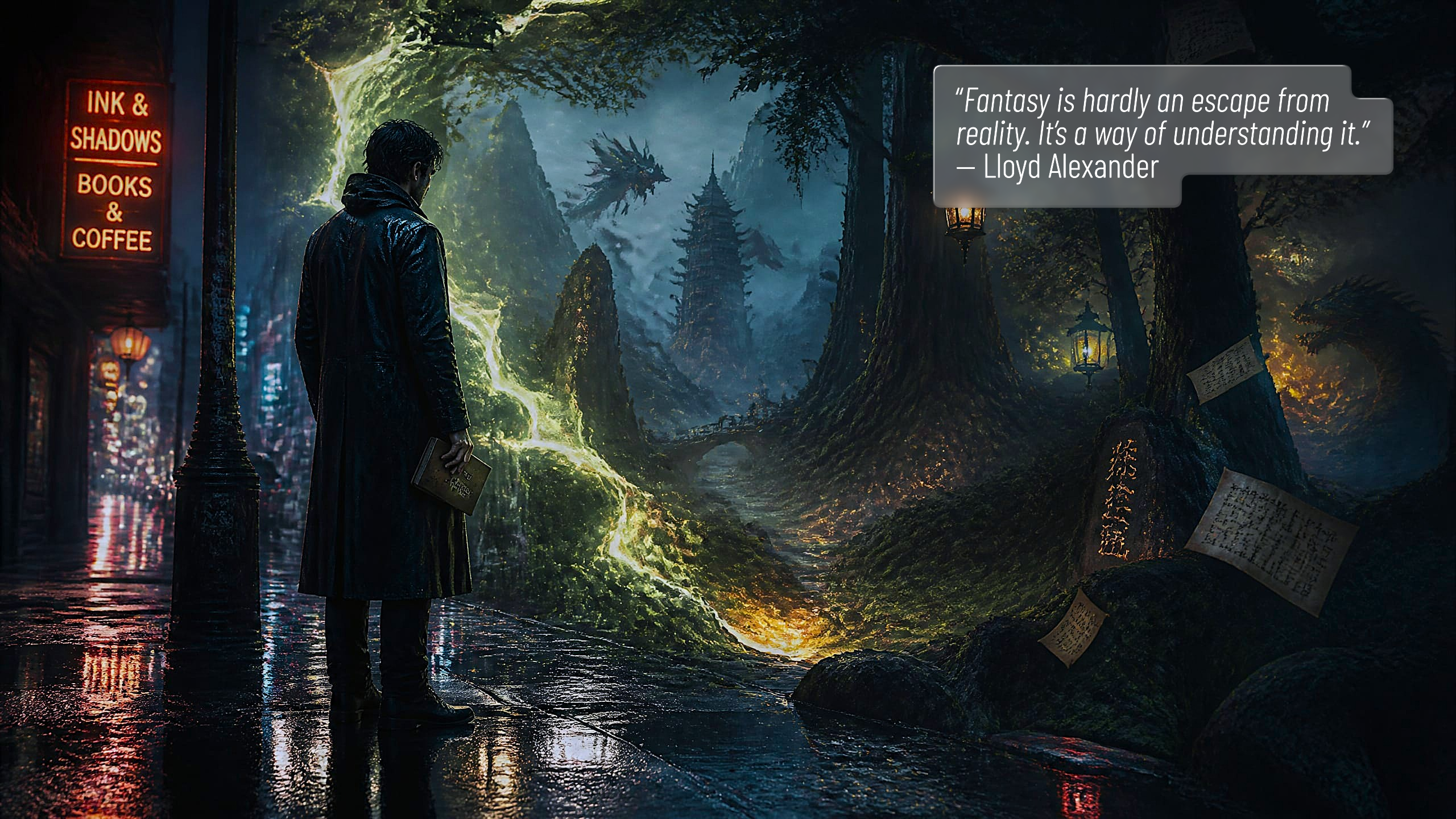
It lets us look at power without naming the king. It lets us study grief inside a haunted forest, courage inside a child facing monsters, corruption inside an empire made of shadows. The invented world becomes a mask truth wears so we are brave enough to keep looking.
That is the real power of fantasy.
Not escape from reality.
Escape into a deeper version of it.
Because reality is not only what can be touched. It is also what can be feared, longed for, remembered, and survived. Fantasy gives those invisible things bodies. It turns loneliness into a tower, trauma into a curse, hope into a hidden door waiting beneath the ruins.
Writers understand this instinctively.
Sometimes the truth is too bright to stare at directly. So we tilt it through myth. Through monsters. Through strange kingdoms and broken prophecies and impossible roads. We create distance not to avoid the wound, but to see its shape without being swallowed by it.
That distance can become mercy.
A reader enters a made-up world and finds something painfully familiar waiting there. A dragon becomes addiction. A locked tower becomes depression. A cursed bloodline becomes inherited silence. The fantasy gives shape to what ordinary language keeps failing to hold.
Maybe that is why certain imaginary places stay with us longer than real ones.
They are not merely invented.
They are emotionally accurate.
And emotional accuracy is often the kind of truth people remember most.
Reflective Prompt
What imaginary story, myth, or world helped you understand something real about yourself?

