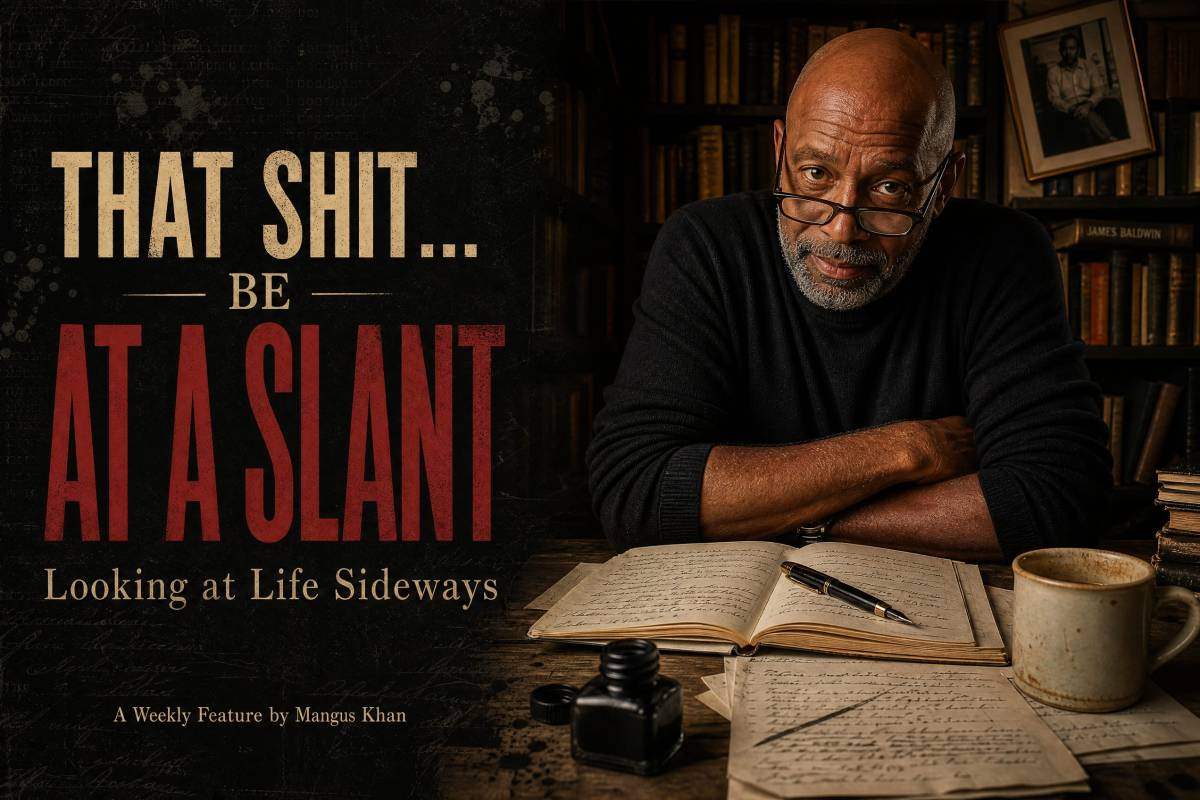
Hello, I’m Mangus Khan, and for the next few minutes, I encourage you to walk into Madness with me.
Come on in, Brave Souls.
Pull up a stool.
Apparently the bartender has heard everything already.
And judging by his face, some of you motherfuckers need therapy.
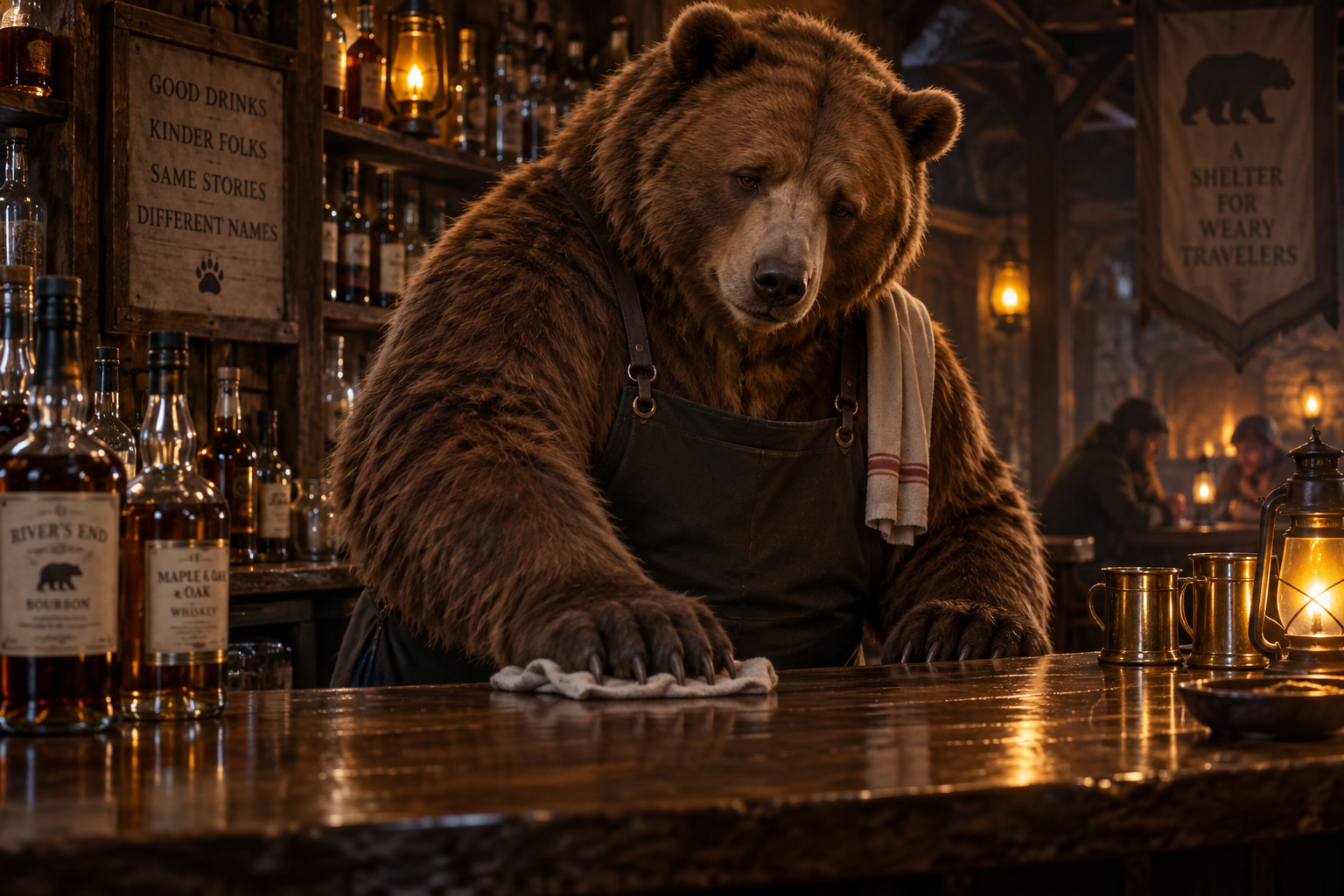
The bar is warm in that particular way old bars get warm—not comfortable exactly, but inhabited. Amber light pools beneath battered lamps. Whiskey bottles stand shoulder to shoulder behind the counter, their glass throwing fractured pieces of gold against dark wood. The room smells of bourbon, damp coats, fried something-or-other from a kitchen nobody has inspected closely enough, and decades of conversations soaked into timber.
Somewhere near the back, somebody laughs too loudly.
A chair scrapes.
Ice tumbles into a glass.
The bartender wipes the counter.
Again.
He has probably wiped that same spot seventeen times tonight.
Not because it’s dirty.
Because his hands need something to do while you tell him about Susan.
Susan doesn’t understand you.
Apparently.
Susan hasn’t understood you since 2014, but instead of telling Susan, you have decided to tell a six-foot-something bear holding a dish towel.
Fair enough.
Pour the man another drink.
There’s something peculiar about bars.
People walk through the door carrying things they wouldn’t dream of bringing anywhere else.
Loneliness.
Divorce.
Regret.
A promotion.
A firing.
A funeral.
A wedding.
The phone call from the doctor.
The kid who finally came home.
The kid who hasn’t called.
The woman you should have married.
The woman you did.
Sometimes they’re the same woman.
Life is complicated.
The bartender listens.
Maybe he nods.
Maybe he gives you another inch of bourbon.
Maybe he says nothing because somewhere along the way he learned that silence, properly administered, is one hell of a medicine.
Then you leave.
And that’s the part we don’t think about.
You leave.
Your story doesn’t.
A little piece of it stays behind.
Not literally, of course.
At least I hope not. This isn’t that kind of bar.
But human beings leave residue.
Emotional fingerprints.
A sentence.
An expression.
The tremble in someone’s hand when they lift the glass.
The way a man says he’s fine while staring into something eighty proof.
The woman who keeps checking her phone even though she already knows he isn’t going to call.
The old guy who orders two drinks.
One for himself.
One for the empty stool beside him.
Everybody leaves something on the bar.
And somebody has to wipe it down.
That got me thinking about the people we unload ourselves onto.
Bartenders.
Waitresses.
Barbers.
Hairdressers.
Nurses.
Cashiers.
Janitors.
The woman working the hotel desk at two in the morning.
The mechanic leaning beneath your hood while you’re explaining that the engine started making a ka-chunka-ka-chunka noise somewhere around Peoria.
We tell strangers extraordinary things.
Sometimes because strangers are safe.
They don’t know the other characters.
They weren’t there.
They have no investment in the ending.
For ten minutes, they can simply listen.
Then we thank them.
Hopefully tip them.
And walk away feeling a little lighter.
But here’s the slant.
Where does the weight go?
We rarely ask.
We assume service workers disappear when we stop looking at them.
It’s an interesting little piece of human arrogance.
The bartender exists when we need a drink.
The waitress exists when we’re hungry.
The custodian exists when something needs cleaning.
The nurse exists when we’re hurting.
Then we walk out the door, and somewhere in the primitive little machinery of our minds, they return to storage until needed again.
Except they don’t.
They go home.
They have mortgages.
Bad knees.
Children.
Parents getting older.
Relationships falling apart.
Dreams postponed so many times they’ve stopped calling them dreams.
They sit in cars after shifts with both hands on the steering wheel, gathering enough energy to drive home.
They have mornings when getting out of bed requires negotiation.
They have people they miss.
They have people they’re trying desperately to forget.
They have their own Susans.
And yet tomorrow, they’ll put on the apron.
Tie the shoes.
Turn on the lights.
Unlock the door.
And ask us:
What can I get you?
There’s something profoundly human about that sentence when you think about it.
What can I get you?
Most of civilization seems built around somebody asking somebody else that question.
What can I get you?
What do you need?
How can I help?
Where does it hurt?
Would you like fries with that?
Some versions sound more noble than others.
The function isn’t terribly different.
Human beings taking care of human beings.
For money, certainly.
Let’s not romanticize labor into some bullshit inspirational poster.
The bartender isn’t pouring bourbon because the universe called him to your spiritual journey.
He has rent.
The waitress isn’t bringing pancakes because serving mankind fulfills her soul.
She’s working.
And work can be exhausting, repetitive, underpaid, thankless shit.
That’s precisely why kindness matters.
Not because service is noble.
Because the person doing it is human.
There’s a distinction.
We’ve gotten strangely comfortable confusing occupation with identity.
He’s a bartender.
She’s a waitress.
He’s the janitor.
No.
That’s what they’re doing when you happen to encounter them.
You don’t know who they are.
That’s an entirely different question.
Maybe the janitor paints.
Maybe the waitress is finishing a degree.
Maybe the cashier writes poetry during lunch.
Maybe the bartender goes home after listening to everybody else’s problems and sits quietly at his kitchen table because nobody has ever asked about his.
That possibility bothers me.
Because I wonder how many people I’ve walked past without seeing.
Not deliberately.
That’s the easy defense.
I wasn’t cruel.
I didn’t insult anybody.
I said thank you.
Fine.
But there is a considerable distance between not being an asshole and actually recognizing another human being.
Age has made me increasingly aware of that distance.
Maybe because I’ve spent enough time on both sides of invisible counters.
Maybe because eventually you understand everybody is carrying something.
The man moving slowly in front of you might have buried somebody yesterday.
The cashier who seems distracted might be wondering how she’s going to pay the electric bill.
The waitress who forgot your extra ranch dressing may be working a double after sleeping four hours.
Or maybe she’s just having a shitty day.
You’re allowed those too.
Funny how generously we excuse our own bad days while demanding strangers maintain professional-grade emotional stability during theirs.
We want grace wholesale and distribute it retail.
There’s some shit at a slant for you.
The bartender wipes the counter again.
The rag makes a soft dragging sound against the polished wood.
Someone calls his name.
He looks up.
Another glass.
Another story.
Another person needing something.
He reaches for the bottle.
Maybe tonight somebody will ask him a different question.
Not—
Can I get another?
Not—
You got anything stronger?
Not even—
What do I owe you?
Maybe somebody will look across that worn wooden counter and ask:
How are you doing tonight?
And then actually wait for the answer.
Small thing.
Probably won’t fix the world.
Hell, it won’t even fix Susan.
But civilization has always depended more on small kindnesses than grand declarations.
Holding the door.
Learning someone’s name.
Looking at the cashier instead of your phone.
Thanking the custodian.
Tipping the waitress.
Giving the exhausted clerk thirty seconds of patience.
Recognizing that the person standing on the other side of whatever counter separates you has an entire life you know absolutely nothing about.
The bar is quieter now.
Last call came and went.
Chairs are upside down on tables.
The whiskey bottles have stopped glowing because somebody turned off half the lamps.
Outside, tires whisper over wet pavement.
Inside, the bartender wipes the counter one final time.
The stories are gone.
Their weight isn’t.
Tomorrow he’ll unlock the door.
Someone will sit down.
A glass will hit the wood.
And another human being will begin:
You wouldn’t believe the day I’ve had.
Maybe that’s what we are.
Weary travelers wandering into each other’s lives for a few minutes, leaving pieces of ourselves behind.
Same stories.
Different names.
So be careful what you leave on the bar, Brave Souls.
Somebody has to wipe it down.
We’re on a journey through the ordinary and mundane, taking off the rose-colored glasses and looking for a different side of Madness.
Sometimes all it takes is looking across the counter instead of at what’s sitting on it.
Tilt your head a few degrees.
Look again.
Because sometimes…
That Shit … Be at a Slant.
Discover more from Memoirs of Madness
Subscribe to get the latest posts sent to your email.


Weary travelers wandering into each other’s lives for a few minutes, leaving pieces of ourselves behind. Love this! I came to the same realization (well forever ago) and I was humbled. That man or woman, has a life, and perhaps it isn’t going as well as they’d hoped. They have a daily grind, problems, concerns, perhaps health issues, or failing issue of family member. Yet they are professional. They keep it to themselves while inadvertently offering you a hearing ear. And yes, sometimes saying nothing, just listening lifts a burden. Does it add to theirs? I think probably so, on occasion. So yes, be kind, leave them with peace if you unburdened yourself. Thank you. or Hope the rest of your days goes well and if there are concerns and worries, you have someone to talk to. Just saying
LikeLike
🙏😉
LikeLike