The watch stopped at dawn.
Not the gentle kind—the kind that slips in like forgiveness—but the gray, flooded dawn that arrives already tired of you. The kind that stains the sky a murky color that refuses to decide whether it’s night or morning, as if time itself has begun to disapprove of forward motion.
I noticed it when the ticking failed to meet me halfway.
For years, that sound had been my anchor. A soft, mechanical breath in the hollow of my chest pocket. Tick. Pause. Tick. A reminder that something, somewhere, still obeyed order. Still moved forward in increments small enough to survive.
Now there was only water.
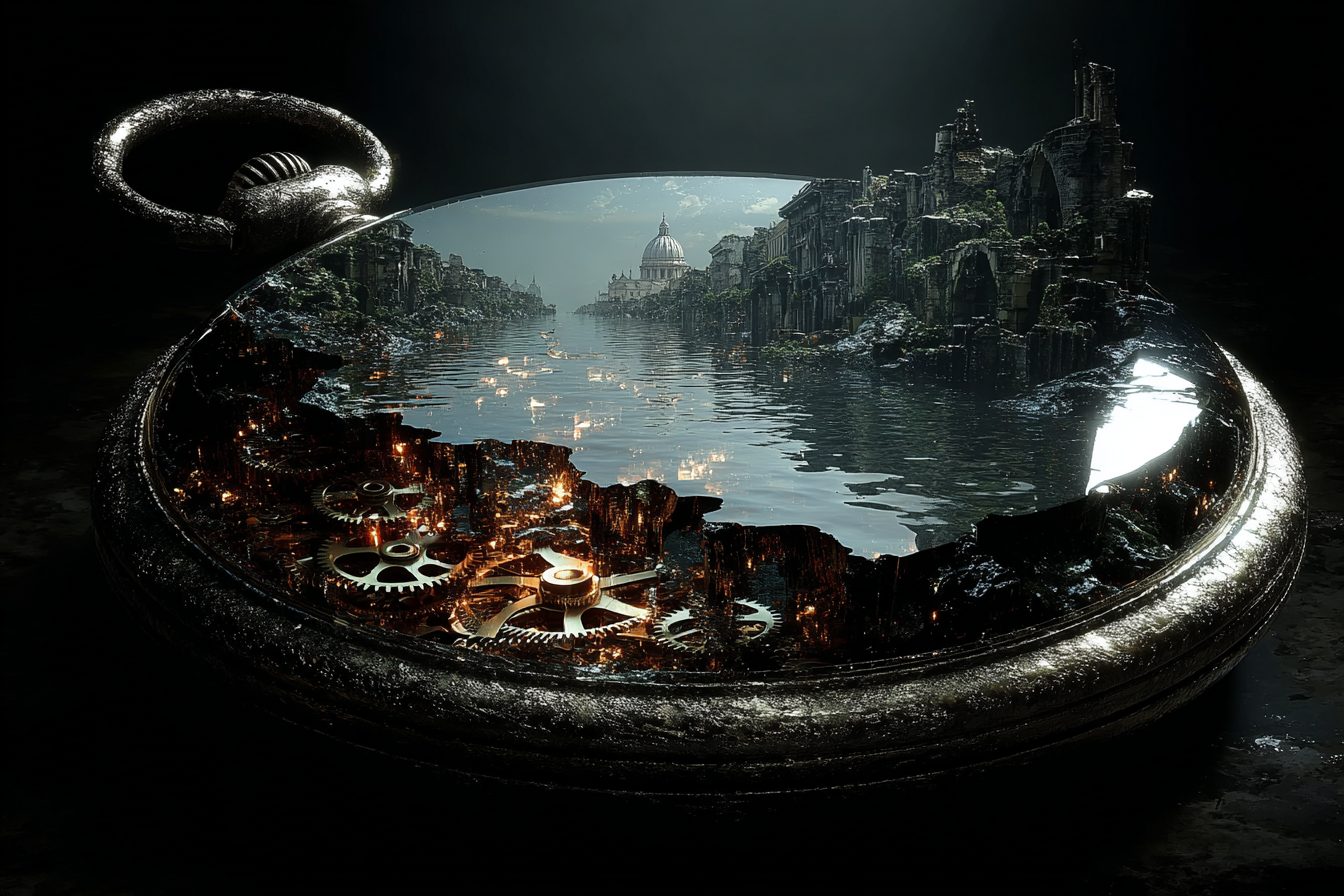
The glass face of the pocket watch had cracked sometime during the night, a hairline fracture running from two o’clock to nowhere. Inside, the city floated—half-submerged streets, collapsed facades, moss choking the bones of once-important buildings. Windows gaped like mouths that had finally given up trying to warn anyone. At the center, a domed cathedral rose from the flood like an accusation that refused to sink.
It was still captivating, in the way ruins sometimes are. Beauty sharpened by consequence. Grandeur stripped of purpose.
Beneath the waterline, the gears burned.
Gold teeth turned against blackened brass, grinding despite the damage, throwing sparks like dying stars. The machinery didn’t care that the watch had failed. It kept working out of habit. Out of loyalty to a purpose that no longer mattered.
I understood that better than I wanted to.
I stood at the edge of the canal that used to be a boulevard, boots half-submerged, coat heavy with the smell of damp wool and old decisions. The city had been abandoned for years, but it still whispered at night—stones settling, water licking the edges of memory, echoes that sounded uncomfortably like names I never said out loud.
I remembered a morning before the flood. Before the watch felt heavy.
We sat at a narrow table near the window, steam curling from chipped cups of tea, the kind brewed too long because neither of us wanted to be the first to speak. She stirred hers slowly, counting rotations like they meant something, then slid a coin across the table.
“A tuppence for your thoughts,” she said.
She didn’t smile.
I should have laughed. Should have told her the truth. Instead, I pocketed the coin like a coward’s joke and said nothing worth keeping.
I promised her I’d leave before the waters rose.
I always said that part softly, as if volume could erase delay.
“You have time,” I told her.
I believed it. Or worse—I needed to.
The watch had been hers first. A gift from her father, salvaged from a world that still believed time could be trusted. She gave it to me the night I chose to stay. Pressed it into my palm like a pardon I hadn’t earned.
“So you don’t forget,” she said.
I didn’t forget.
That was the cruel part.
The floods came fast after that. Streets drowned, then buildings, then names. People scattered or vanished. Promises calcified into artifacts. I stayed long enough to become part of the ruin—another figure haunting the edges of what refused to die.
When the betrayal finally surfaced, it wasn’t loud.
It never is.
It arrived as understanding.
The realization that the city hadn’t fallen because of the water, but because of what I didn’t say when it mattered. Because of every moment I stood still while she carried the weight of forward motion. Because love deferred long enough begins to rot, and rot attracts floods.
I had thrown silence where honesty should have been.
Thrown comfort at a wound that needed truth.
Thrown time away as if it were renewable.
I opened the watch fully, prying the glass away with numb fingers. Water spilled out, carrying reflections with it—her face once, briefly, before dissolving into ripples. Beneath it all, the gears slowed.
Tick.
Pause.
Nothing.
For the first time, the city inside the watch went quiet.
No sparks. No movement. Just submerged streets and a cathedral that had finally learned how to bow.
I closed the watch and let it sink into the canal.
The water swallowed it without ceremony.
I stood there long after the ripples faded, hands empty, pockets lighter, time finally finished with me. The city remained—not as punishment, not as mercy—but as evidence.
Some things don’t break when you betray them.
They simply stop keeping time for you.
Author’s Note
This piece was shaped in conversation with constraint, and I’m grateful for it. Thank you to Di for hosting 3TC, and to Ragtag Daily Prompt for consistently offering challenge words that don’t feel ornamental, but invitational—words that ask to be earned on the page.
These prompts didn’t dictate the story; they pressured it, forcing choices, memory, and consequence to surface where they might otherwise have stayed submerged. Sometimes that tension is exactly what a piece needs to tell the truth it’s been circling.
I appreciate the space to wrestle with language rather than decorate it.
 Memoirs of Madness
Intriguing story and your comments about RagTag Daily Prompt made me happy. It’s not always easy to come up with something that could lead somewhere. Thank you.
LikeLike
Thanks for including the 3TC in your piece Mangus. Another good one my friend.
LikeLike
This story reminds me of Quentin Compson, with his grandfather’s watch, on the bridge where he will soon, despondent over his love for his sister Cally, jump to his death (I have to go look it up now I love this passage so much one of my favorites in all of fiction):
June Second, 1910
“I give it to you not that you may remember time, but that you may forget it now and then for a moment and not spend all your time trying to conquer it. Because no battle is ever won he said. They are not even fought. The field only reveals to man his own folly and despair, and victory is an illusion of philosophers and fools. . . It’s always the idle habits you acquire which you will regret. Father said that. That Christ was not crucified: he was worn away by a minute clicking of little wheels. That had no sister.”
—William Faulkner, The Sound and the Fury
LikeLiked by 1 person
You stole my thunder👍. The essay was indeed reminiscent of Faulker.
LikeLiked by 1 person