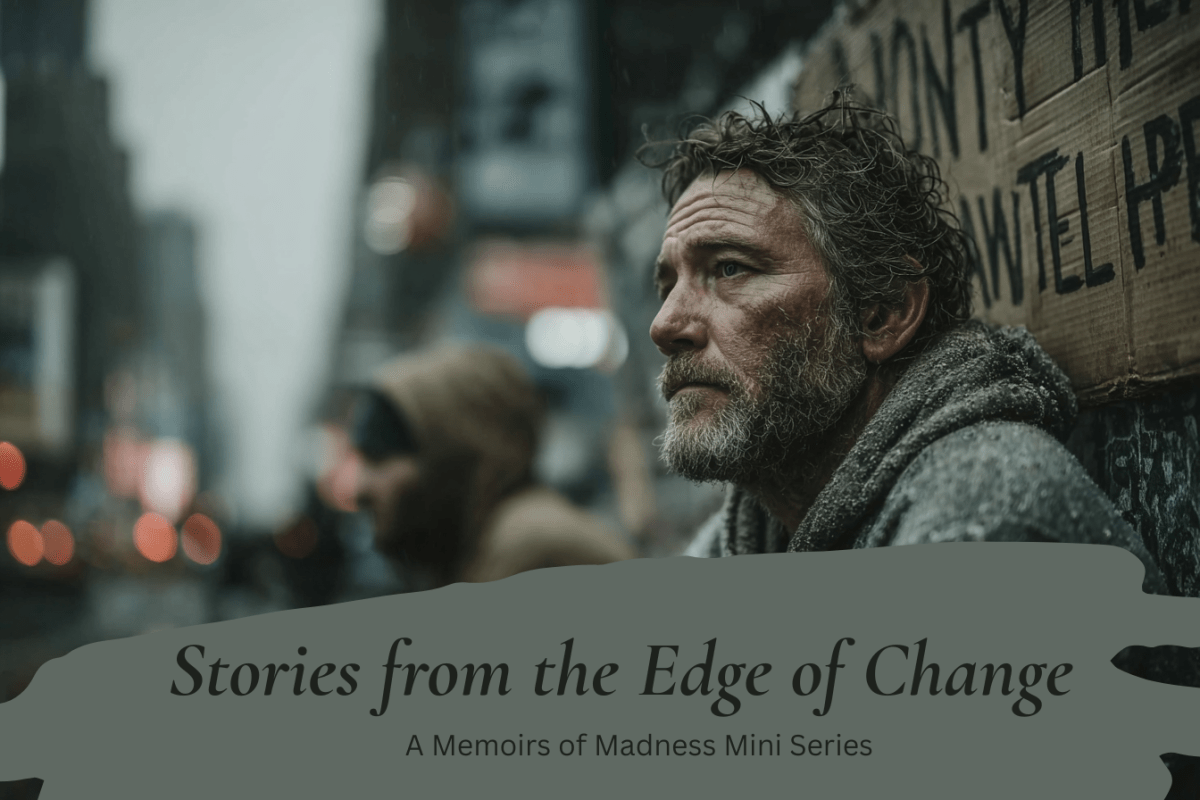
Stories from the Edge of Change – Volume 2, Part 1
“They said the system lost track of him. But he was never theirs to keep.”

The morning rain didn’t bother Ren. He’d learned that water was gentler than people.
He crouched beside the alley dumpster behind the drop-in center, shoulders hunched under a threadbare hoodie two sizes too big, sleeves eaten at the cuffs. His shoes—untied and uneven—squished when he shifted his weight. Rain pooled around the soles, but he stayed put, drawing loops on a soggy intake form with a chewed Bic pen. The form was from three weeks ago. He didn’t remember if he ever turned it in. Didn’t matter.
It was quiet this early. The kind of quiet that makes everything louder. His breath. His heartbeat. The clack of metal shutters two streets over. His fingers trembled, but not from cold.
He hadn’t slept inside in nine days.
But he knew where the cameras were, where the streetlights stopped working. Which stairs stayed dry?
He used to think that was survival. Now it just felt like memorizing a test he’d never pass.
A city bus hissed to a stop up the block, brakes squealing like something in pain. He looked up for a second, then back down. He’d been in those buses, once. With trash bags full of his stuff. Being transferred. “Transitioned.” “Placed.” Words that meant temporary. Always.
The folder in his backpack held every proof of his existence that the county ever gave him:
- Two expired Medicaid cards
- A GED prep schedule with coffee stains
- A letter saying he was denied transitional housing
- A single photograph, sun-bleached and wrinkled: him and Miss Tanner, his last foster placement, grinning with sparkler smoke behind them
He’d never shown that picture to anyone. He wasn’t even sure if the smile was his.
Sometimes he felt like that photo was the only place he still left a fingerprint.
Inside the drop-in center, they’d already started handing out coffee and hygiene kits. Ren didn’t go in. Not yet. He didn’t want to be seen with wet hair and a panic attack crawling just beneath the skin.
He’d been in a group home once that called itself “trauma-informed.” They still lock the bathroom at night.
He’d rather piss in the alley than ask permission again.
A man passed by, muttering to himself, trailing a shopping cart full of pillows and clinking bottles. Ren didn’t flinch. The cart guy nodded, as if he knew him. Maybe he did.
He did know the feeling: You’re alone but not exempt. Not from the weather. Not from the noise. Not from the memory of being fifteen, hands shaking as a caseworker said, “We’re placing you in a new home.” She said it like it was an opportunity, not another stab wound in a file no one would read.
The sky split open with a gust of cold air, and Ren finally stood. Pulled his hoodie tighter. Slipped the intake form into his back pocket. It had his name spelled wrong anyway.
He stepped out from behind the dumpster, not into confidence or comfort, but into motion. He moved the way you do when no one’s expecting you—not slow, not rushed, just enough to stay above notice.
As he passed the shelter entrance, he saw a boy younger than him sitting on the stoop, wrapped in a trash bag and drawing in the condensation on the glass door.
They didn’t speak. Just exchanged a glance. The kind that said: Yeah, I see you. No, I won’t say your name.
Ren knew that sometimes a glance was the only shield you had left.
He kept walking toward the corner, toward the same coffee shop he never entered, where the manager never made eye contact and the workers tossed day-old bagels out at 11:00. He’d wait nearby. Not to beg. Just to exist adjacent to someone else’s comfort.
This was the work.
Not recovery.
Not healing.
Just… enduring without disappearing.
He passed a torn flyer taped to a lamppost—one of those mental health outreach posters that still had a suicide hotline and a QR code for free therapy that didn’t exist anymore.
Someone had scrawled across the bottom in Sharpie:
“Hope is just the thing they say when they have nothing left to offer.”
Ren stopped.
He stared at that line for a long time.
Then smiled, just barely.
Not because it was funny.
But because he’d believed in hope once—and he’d watched it falter in real time.
Author’s Note
Written for Stories from the Edge of Change – Volume 2.
This piece responds to today’s word prompts:
- Falter (FOWC – Fandango’s One Word Challenge)
- Shield (Ragtag Daily Prompt)
- Fingerprint (Word of the Day Challenge)
Ren is fictional, but his story is rooted in reality—lived, endured, and too often ignored.
This piece isn’t about rescue or redemption. It’s about what it costs to keep going when the world has already filed you away.
Some people carry their past in manila folders.
Some names vanish before they’re ever called.
And some stories live in silence until someone listens.
Thank you for reading. Let me know if you’re ready to meet the others.
 Memoirs of Madness
💓
LikeLiked by 1 person
thank you
LikeLiked by 1 person
“Just to exist adjacent to someone else’s comfort.” aren’t those words a whiff of strong coffee.
LikeLiked by 1 person
smiles … thank you
LikeLiked by 1 person
Anther good piece of writing Mangus. Reminds me a little of the fosters I had, always short term, but I hoped their time with me gave them something akin to security and support when they needed it.
LikeLiked by 1 person
thanks, Di
LikeLike
oops, typo, should read ‘another’…………. hands aren’t working too well today.
LikeLiked by 1 person
Very interesting to get. glimpse into the life of those we see sitting on the sidelines.
LikeLiked by 1 person
thank you
LikeLiked by 1 person
“Enduring without disappearing.” Poignant words that describe too many immersed in a culture that’s losing the narrative. Well done, Mangus.
LikeLiked by 2 people
thank you
LikeLike