The city began with a spill.
It was late—late enough that the street outside my apartment had given up pretending to be alive. The only sound was the dull hum of traffic somewhere far off, like a river that had forgotten its name. I was working at the old wooden table, the one scarred with knife marks and cigarette burns from a life I never lived but inherited anyway.
I knocked the bottle over without ceremony.
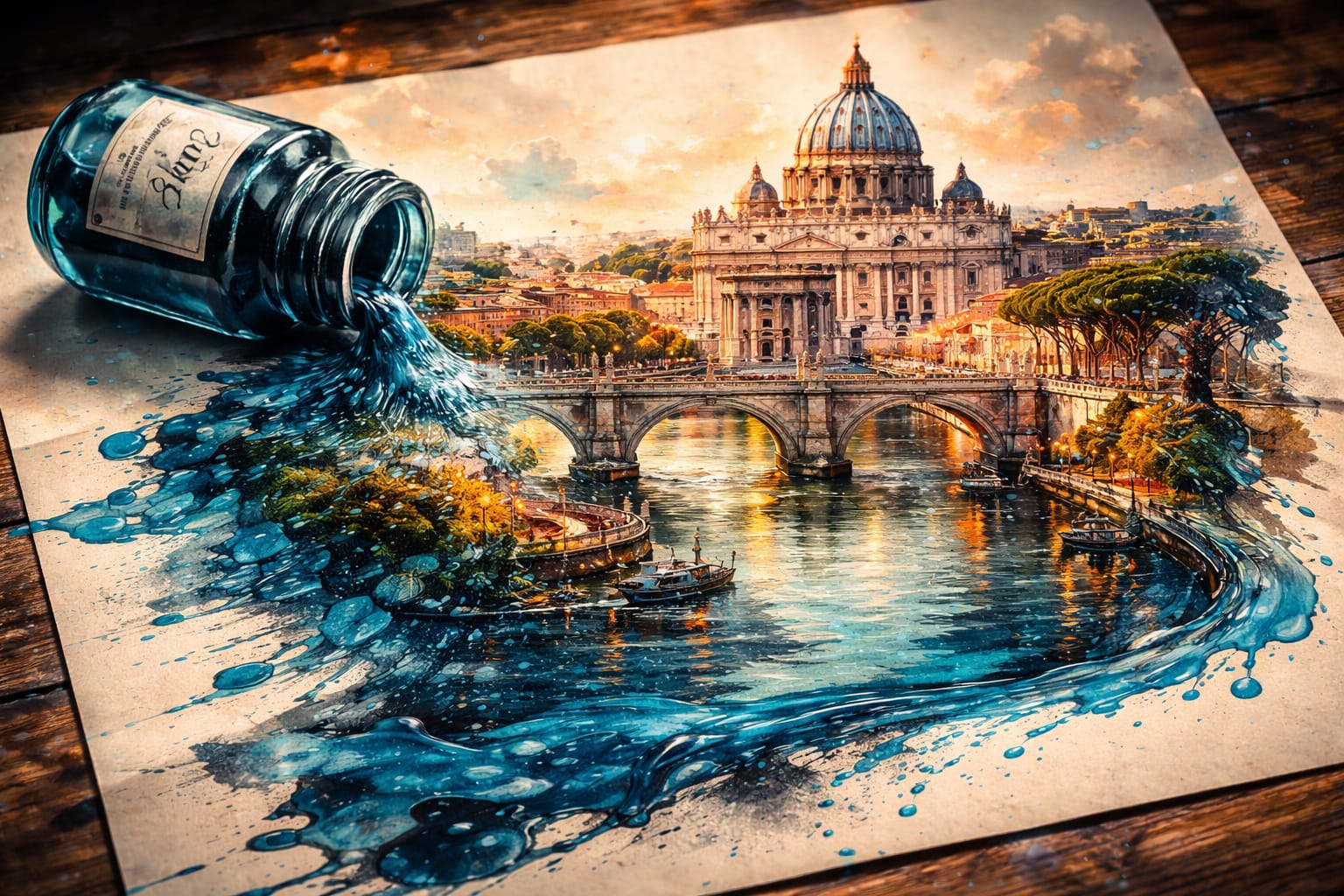
Blue ink bled across the paper I had been meaning to use for something important. A letter. A resignation. A confession. I can’t remember which now. The liquid pooled, then gathered itself like it had somewhere better to be. It rolled, curved, stretched into streets and shadows. I should have grabbed a rag. Instead, I watched.
The river formed first.
It cut across the page in a confident sweep, widening near the center as if it had known for centuries where it belonged. Bridges rose from the dark—arched and patient. Trees leaned in with the quiet posture of witnesses. And then the dome appeared, pale and stubborn against the gold of an imagined sunset.
Rome.
I’ve never been.
But there it was, blooming out of my clumsiness. The ink bottle lay on its side like a drunk god, label peeling, mouth still weeping blue. What spilled was not waste. It was architecture. It was history I hadn’t earned.
I leaned back and let the chair creak. On the edge of the table sat a plane ticket I’d bought three weeks ago in a fit of defiance. One-way. No return. No explanation to anyone. I told myself it was courage.
Truth is, I didn’t know if I’d use it.
The city on the page shimmered in the lamplight. Boats drifted in the inked river. Tiny wakes cut through the dark blue like whispered promises. I could almost hear the murmur of evening voices, the slow saunter of footsteps along stone streets warmed by centuries of confession.
That’s the thing about cities—you don’t walk through them. You let them walk through you.
I reached out and touched the edge of the river. My finger came back stained. It looked like a bruise.
Maybe that’s what travel really is. Not escape. Not reinvention. Just pressing your wound against another landscape and seeing which one bleeds more honestly.
I stared at the ticket again. Departure in two days. Non-refundable. I had told myself Rome would fix something. That distance was a solvent. That if I stood beneath that dome and let the weight of marble and memory press down on me, whatever inside me felt cracked would finally align.
But the city was already here.
It had spilled itself onto my table without permission. It had refused to wait for customs or currency exchange. It existed whether I boarded the plane or not.
Outside, a car passed. The hum faded.
I imagined myself there—hands in pockets, moving with a deliberate saunter along the Tiber, not rushing, not chasing absolution. Just walking. Letting the stones judge me if they must.
The ink was drying now. The river settling. The dome fixed in place.
Maybe I don’t need to go to Rome.
Or maybe Rome has already come to collect.
I picked up the bottle and set it upright. The label read simply: Blue.
But nothing about this felt simple.
I left the spill untouched. Some things aren’t accidents. Some things are invitations.
The ticket remained on the table, catching the lamplight.
Waiting.
 Memoirs of Madness