
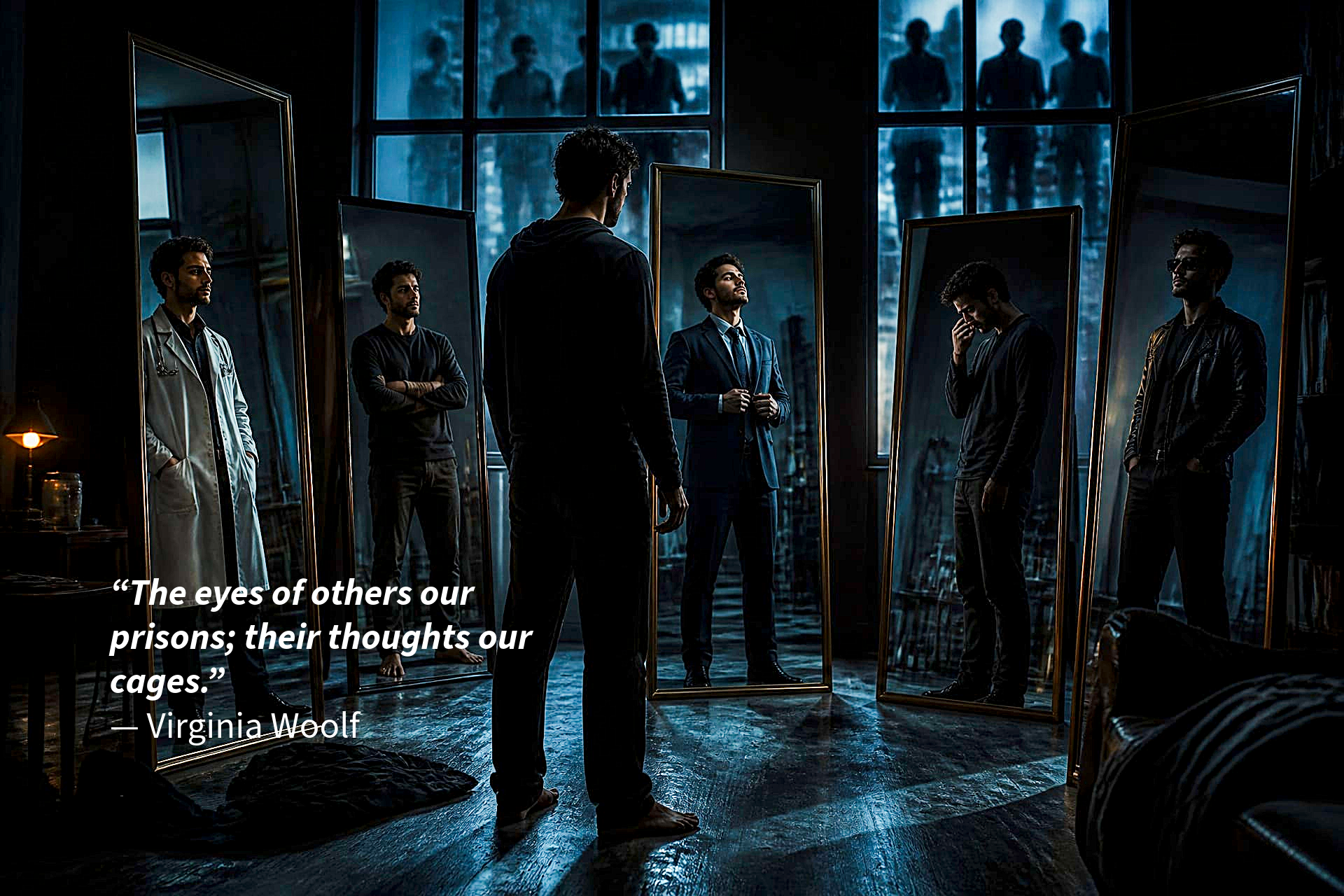
Personal Reflection
At first glance, it sounds almost paranoid—as if simply being seen by other people is dangerous. But the longer you sit with it, the more familiar it becomes. Because most people know what it feels like to adjust themselves under observation. To become slightly different depending on who is watching.
A little quieter here.
A little tougher there.
A little less honest in rooms where honesty feels expensive.
That’s the exhausting thing about living too long inside other people’s perceptions—you slowly lose track of your natural shape.
Not all at once. Gradually.
You start anticipating judgment before it arrives. Editing yourself before speaking. Softening pieces of your personality that once felt instinctive because somewhere along the line you learned certain truths made people uncomfortable.
And eventually the performance becomes so consistent that even solitude doesn’t fully remove it.
That’s when the cage becomes dangerous.
Because external expectations have a way of becoming internal architecture. You begin carrying invisible audiences into private moments. Imagining how your grief appears. How your body appears. How your failures appear. Even your healing starts becoming something silently measured against what looks acceptable to others.
Mental exhaustion grows quickly in that environment.
Not simply from being judged—but from constantly monitoring yourself through imagined judgment. It fractures attention. Splits identity. Turns ordinary human vulnerability into something that feels like exposure under interrogation lights.
And perhaps the cruelest part is how easy it becomes to mistake approval for peace.
You learn how to become readable. Palatable. Successful at being the version of yourself that causes the least friction in the room while the deeper, stranger, less polished parts remain hidden somewhere behind the performance.
But hidden things do not disappear.
They wait.
And the longer they remain unseen, the harder it becomes to remember whether you’re living authentically… or merely maintaining emotional camouflage.
Maybe freedom isn’t reaching a point where nobody judges you. That will never happen.
Maybe freedom begins the moment you stop building your identity entirely around avoiding judgment in the first place.
The moment you stop asking:
“How will this make me appear?”
…and start asking:
“Does this feel true when I’m alone with myself?”
Because eventually there comes a quiet exhaustion from living as someone constantly observed.
And at some point, the soul starts wanting air more than approval.
Reflective Prompt
What parts of yourself became hidden because you learned they were easier for others to accept that way?
Discover more from Memoirs of Madness
Subscribe to get the latest posts sent to your email.


A little less honest in rooms where honesty feels expensive. A little less honest in rooms where honesty feels expensive. Those are true realities, arent they….I’m no longer in fear of being judged..have at her…but I won’t accept it for long..if its a continued behavour, im out
LikeLike
I’m good at hiding being hurt. I always have been, even as a child, as I would laugh or poke fun at myself before others did. I was the brunt of jokes and put downs to make others look good, some saying I was over sensitive, and not to take it to heart. At a young age, it molds you and strips you of confidence.
My late MIL hurt me often with her remarks, whether intentional or not, but I managed to mask it. One day she said something cruel and nasty which cut me to the quick, so I went into the kitchen to make tea rather than give her the satisfaction of seeing me cry. In later years, I learned to hold my anger at the way she treated my husband.
LikeLike