Quote of the Day – 11142025


Personal Reflection:
We talk about peace like it’s a luxury reserved for quiet places — a cabin in the woods, a meditation hall, a Sunday morning before the world wakes up. But most of life isn’t built that way. The refrigerator hums, the neighbor argues, the mind won’t stop rehearsing the same tired fears. The truth is, the world never actually gets quiet. The only silence that exists is the one we learn to make inside ourselves.

And maybe that’s what peace really is — not the clean absence of sound, but the ability to listen differently. The ability to hear the chaos without letting it dictate the rhythm of your heart.

Noise isn’t the enemy. It’s information. It tells you where your boundaries are, where you’re leaking energy, where you’ve been refusing to pay attention. The chatter of the world mirrors the clutter of the mind. You can’t mute it into submission; you have to translate it.

The hard truth is that sometimes the noise comes from within — the self-criticism disguised as ambition, the anxious loop of what-ifs, the memory you keep replaying because it still hasn’t forgiven you. And the more you resist it, the louder it gets. Real peace begins when you stop negotiating with your noise and start listening to what it’s trying to say.

For me, the lesson came late. I used to believe calm required control — that if I could just fix everything, I’d finally get to rest. But control is just another kind of noise. It’s fear dressed as order. You can’t think your way to stillness. You have to surrender to it, one heartbeat at a time.

Peace is a skill — one you practice in traffic, in grief, in uncertainty. It’s learning how to hear the storm without becoming it. To feel the weight of the world without mistaking it for your own. It’s not passivity; it’s presence — the discipline of staying open when everything in you wants to shut down.

Eventually, you realize the noise was never against you. It was your teacher. It forced you to listen, to slow down, to separate what’s urgent from what’s true. When you can hear the world screaming and still keep your soul steady, that’s not luck — that’s mastery.

Peace doesn’t arrive when the noise stops. It arrives when you no longer need the noise to stop in order to feel whole.


Reflective Prompt:
What part of your life feels the loudest right now — and if you listened closely, what truth might that noise be trying to tell you?

Quote of the Day – 11092025


Personal Reflection:
I grew up believing there was always an answer — that effort could fix anything if you just pushed hard enough. Work the problem, find the crack, patch it up, move on. It’s a tidy myth, and it keeps you busy enough to mistake exhaustion for purpose. But life doesn’t run on equations. Some problems aren’t puzzles; they’re mirrors. They don’t want solving — they want acknowledgment.

It’s a strange kind of arrogance, thinking you can be everyone’s medicine. You convince yourself it’s compassion, that you’re being noble — but if you strip away the performance, it’s fear. Fear of being useless. Fear of being replaced. Fear that if you stop fixing, you’ll disappear.

I’ve been the rescuer before — the one patching leaks in other people’s lives while my own foundations quietly rotted. You learn eventually that the act of fixing can become its own addiction. You start confusing love with labor, healing with control. And when things still fall apart, you feel betrayed — by them, by yourself, by whatever god you thought was keeping score.

Sometimes stepping back isn’t surrender; it’s sacred restraint. There’s mercy in recognizing where your reach ends. You can offer presence without performance. You can love without solving. You can bear witness without carrying the weight. That’s not indifference — it’s integrity.

I used to think letting go was a weakness. Now I see it’s the only way to stay whole. You learn to sit with someone’s chaos without trying to quiet it. You learn that love doesn’t mean repairing — it means remaining, even when there’s nothing left to fix.

Freedom begins when you stop trying to be the solution and start listening for what the problem is trying to teach you. Sometimes, what it’s saying is simple: You’re not the cure — you’re the companion. And that’s enough.


Reflective Prompt:
Where in your life are you trying to be the solution — and what truth might reveal itself if you stopped trying to fix it?

Quote of the Day – 11062025


Personal Reflection:

A world where stillness is sacrilege. We treat quiet like failure, reflection like wasted time. Everything demands our reaction before we even know how we feel. Yet devotion begins in the pause. The moment you stop rehearsing and actually witness what’s in front of you, you reclaim something sacred that this world keeps trying to trade for speed.

Paying attention sounds simple until you try it. It asks you to slow down in a culture that worships motion, to sit in the ache of what is instead of racing toward what’s next. It’s not glamorous; it doesn’t make headlines or fill your feed. But when you really notice—really see—something ordinary becomes almost holy. The dust floating in morning light. The pulse behind someone’s trembling hand. The small mercy of being alive long enough to witness either. Attention is the first language of devotion; it’s how we whisper, I’m here.

There’s danger in awareness. The moment you begin to see clearly, the noise you’ve been using as armor starts to crumble. Silence creeps in. Reflection gets heavy. Attention drags old ghosts out of hiding—the ones disguised as ambition, distraction, or pride. To pay attention is to be unguarded before your own life. It means watching yourself fail, ache, forgive, and try again without looking away. Most people don’t avoid stillness because they’re busy; they avoid it because stillness tells the truth. And truth—unlike chaos—doesn’t flatter. It exposes. It humbles. Yet within that humbling, something soft stirs: recognition, grace’s earliest echo.

Grace doesn’t crash in like a miracle. It slips in quietly, through the cracks awareness leaves behind. It’s the hush after honesty, the exhale that follows surrender. The moment you stop performing for your life and start living it. Devotion isn’t about worship—it’s about attention. And grace isn’t about reward—it’s about presence. When you finally look closely enough, even at the ruins, you realize you’re standing on sacred ground.


Reflective Prompt:

What in your life have you been moving too quickly to notice—and what truth might appear if you dared to look longer?

Quote of the Day – 10082025


Personal Reflection:
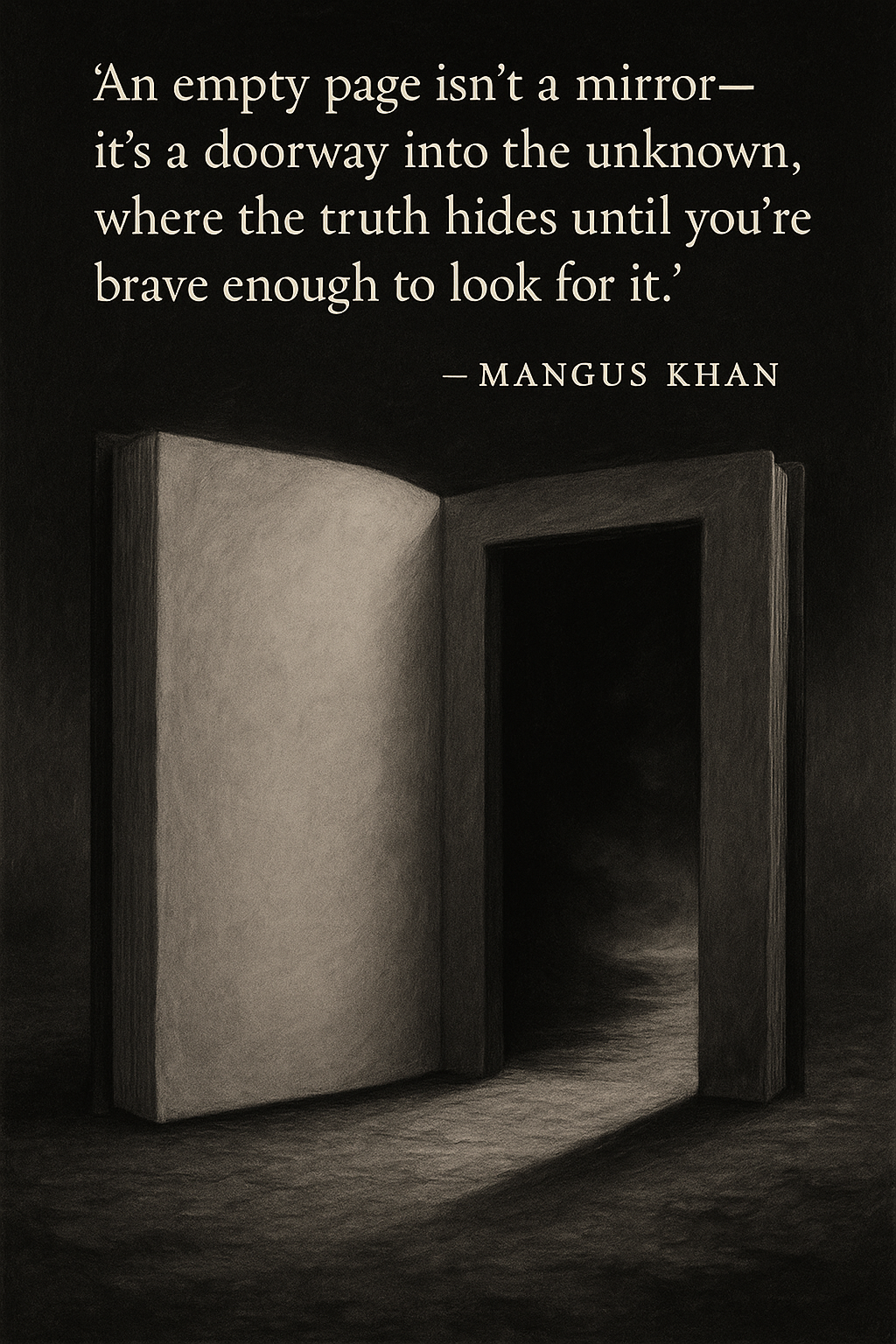
We like to believe we know ourselves, but the page has a cruel way of proving otherwise. It strips away the rehearsed versions—the masks we polish for public view—and leaves us standing there, naked with the truth we almost buried. Writing doesn’t always heal; sometimes it exposes the wound we’ve been pretending isn’t there.
Yet, that’s the beauty of it. The page doesn’t demand perfection, only presence. Each sentence becomes an act of courage, a conversation between who we think we are and who we’re becoming. It’s not the ink that transforms us—it’s the willingness to face what the ink reveals.


Reflective Prompt:
When was the last time your writing surprised you?
What truth emerged from your words that you didn’t know you were ready to face?

Quote of the Day – 10072025


Personal Reflection (Memoirs of Madness Edition)

We like to think writing is an act of control — that we build worlds one word at a time, bending them to our will. But the truth is far less divine. Sometimes we stumble into a story by accident, and other times it drags us down a flight of stairs just to show us who’s really in charge.

That’s the part no one warns you about — the loss of authorship. The realization that the page doesn’t belong to you once the ink starts moving. You can’t force honesty; it bleeds out when it’s ready.

Maybe the act of falling — of tripping over what we meant to write — is where the real work begins. That’s when the masks crack, when the ghosts step forward, when the story stops pretending to be art and starts confessing its truth.

The best stories don’t wait for our permission. They just want us to be brave enough to stay on the floor long enough to listen.


Reflective Prompt for Readers

What stories have you stumbled into — the ones that weren’t part of the plan but somehow revealed a truth you didn’t know you were carrying?